Motorcycle Parts Inventory Management for Pro Dismantlers
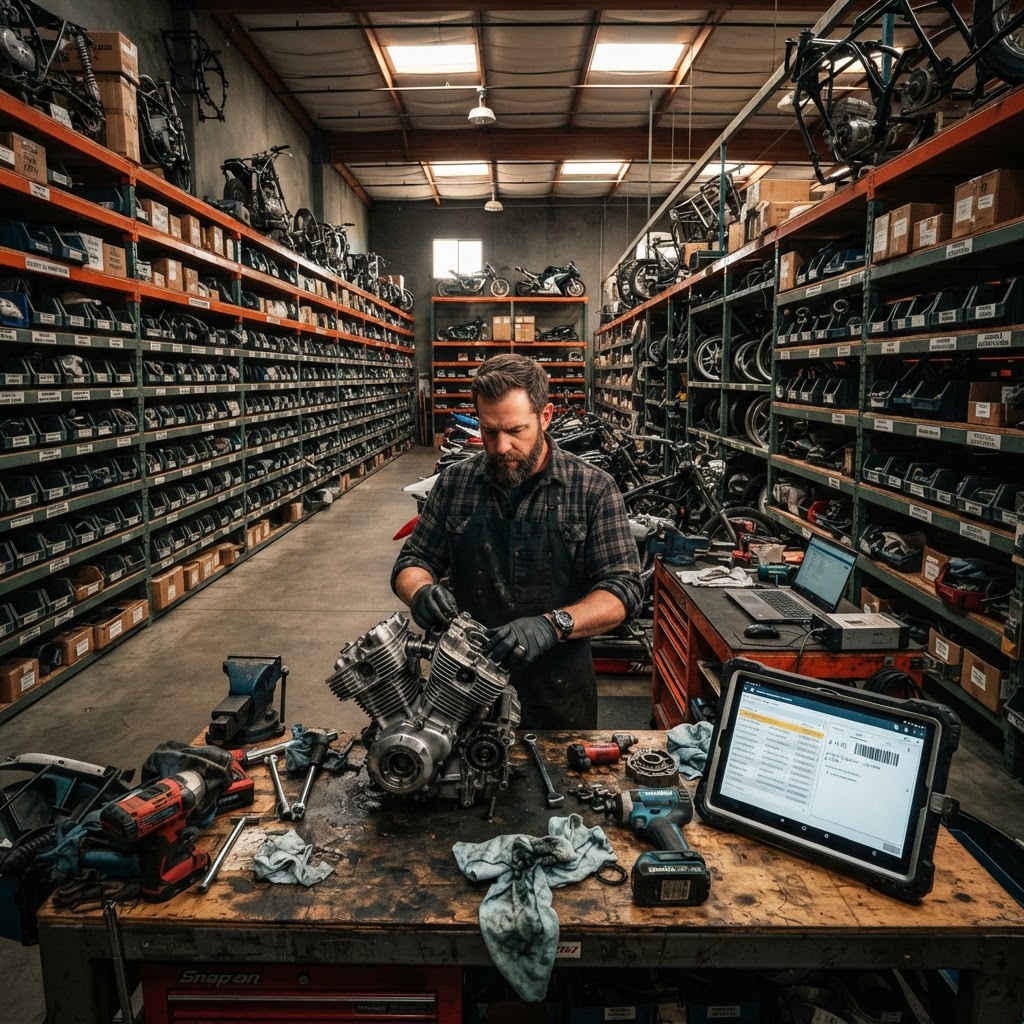
There is a distinct, unmistakable thrill when a freshly acquired salvage bike rolls into the shop. Whether it is a vintage cruiser covered in barn dust or a modern sportbike that met an unfortunate end on the track, the initial process is always the same. You drain the fluids, fire up the impact drivers, and start spinning bolts. Breaking a machine down to its bare frame is highly satisfying, fast-paced work. But any veteran dismantler will tell you a hard truth: tearing down the bike is the easy part. What comes next is where businesses either thrive and scale, or drown in a sea of unorganized components.
When the wrenches stop turning, you are no longer left with a motorcycle. You are left with hundreds of individual components. Every single wire harness, engine cover, fairing, and bolt represents potential revenue. However, without a bulletproof system for motorcycle parts inventory, those components quickly transform from profitable assets into an unmanageable liability. Parts get lost, eBay listings contain inaccurate fitment data, and the sheer volume of components creates a bottleneck that stifles your cash flow.
To succeed in the modern powersports salvage industry, you must transition from being a simple mechanic who takes things apart to becoming a sophisticated logistics expert. Managing thousands of SKUs across multiple sales channels requires specialized strategies, the right warehouse layout, and modern technology. In this comprehensive guide, we will break down exactly how professional dismantlers organize, track, and monetize massive inventories with precision.
The Anatomy of Powersports Salvage Inventory
The powersports industry presents unique logistical challenges that you simply do not find in standard retail or even automotive salvage. When you break down a motorcycle, ATV, or UTV, you are dealing with a staggering variety of parts that differ wildly in size, weight, fragility, and value.
Consider the main categories of a standard teardown:
- Electrical: Wiring harnesses, ECUs, stators, and delicate sensors. These items must be protected from moisture and physical damage.
- Body/Frame: Fairings, gas tanks, fenders, and the main chassis. These are bulky, oddly shaped, and easily scratched.
- Transmission and Engine: Heavy, grease-covered components that require heavy-duty shelving and specialized handling.
- Exhaust: Long, awkward pipes and mufflers that take up significant vertical or horizontal space.
Furthermore, the value of these parts can range significantly. You might have a vintage 1988 Kawasaki KDX200 Spark Arrestor Muffler. ($150) sitting on the same shelf as a simple set of Brute Force 750 Body Hardware ($99.99). You also have highly specific, hard-to-find components like a 1977 yamaha dt400 tachometer cable [43O] PN 1M2-83550-00-00 ($40) that requires exact fitment data to sell successfully. If your inventory management system cannot account for the condition, exact part number, and physical location of each of these vastly different items, your operation will grind to a halt.
Blueprinting Your Physical Warehouse Space
Before you can implement any software or digital tracking, you must master the physical realm. A digital location code is useless if your physical warehouse is a chaotic mess of unmarked boxes.
Professional dismantlers view their warehouse space as a grid. Every square inch must be optimized for fast put-away and even faster picking when an item sells. Here is how top-tier salvage yards organize their physical footprint:
1. The Zone Defense System
Divide your facility into specific zones based on part categories and physical characteristics. For instance:
- Zone A (Heavy & Bulky): Engines, frames, and large wheels. Use industrial pallet racking.
- Zone B (Medium/Standard): Transmission parts, exhaust systems, and suspension components. Standard heavy-duty shelving works best here.
- Zone C (Clean & Fragile): Electrical components, gauges, and delicate plastics. This area should ideally be climate-controlled, or at least free from excessive dust and moisture.
- Zone D (Hardware & Small Bits): High-density drawer cabinets or small plastic bins for bolts, brackets, and cables.
2. Standardized Binning and Labeling
Never rely on memory. Implement a strict alphanumeric bin location system. A standard format looks like this: Aisle-Section-Shelf-Bin (e.g., A-04-02-15). This means Aisle A, Section 4, Shelf 2, Bin 15. Every single shelf and bin must have a clearly visible, printed label.
3. The Teardown and Processing Station
Your tear-down area should be separated from your storage area. It needs to flow logically: a lift for the tear-down, a cleaning station (using ultrasonic cleaners and degreasing tanks), a dedicated photography booth with excellent lighting, and a computer terminal for data entry. This linear flow prevents unlisted parts from accidentally making their way into the storage bins.
The Digital Transition: Embracing Parts Management Software
For decades, dismantlers relied on whiteboards, spiral notebooks, or massive Excel spreadsheets to track their inventory. In today's hyper-competitive e-commerce landscape, these manual methods are a guaranteed way to lose money.
When you are managing thousands of SKUs, a spreadsheet simply cannot keep up. Spreadsheets do not store high-resolution images efficiently, they do not integrate seamlessly with eBay Motors, they cannot automatically update stock levels when a part sells, and they cannot generate shipping labels. This is where dedicated parts management software becomes the most critical asset in your business.
By centralizing your operations within a specialized platform, you eliminate duplicate data entry. When you enter a part into your system, the software should automatically generate a SKU, assign a bin location, format the listing, and push the data directly to your sales channels.
This is exactly why we built RevParts. We designed RevParts specifically for the powersports salvage industry, creating a bridge between your physical warehouse and your online storefronts. With RevParts, you can take a newly dismantled part, enter its details, snap photos, assign it to "Bin C-12", and instantly push that listing to eBay Motors. When the item sells, RevParts updates your inventory, preventing the dreaded double-sale and keeping your metrics perfect.
Mastering SKUs, Tags, and Barcodes
A Stock Keeping Unit (SKU) is the DNA of your inventory system. An effective SKU does more than just identify a part; it tells you and your staff exactly what the part is and where it belongs at a glance.
Crafting the Perfect SKU
Do not use sequential numbers (e.g., 001, 002, 003). They offer no context. Instead, build an intelligent SKU formula. A popular formula for dismantlers is: Year-Make-Model-PartCategory-Unique ID.
For example, if you are listing that vintage tachometer cable, your SKU might look like:
77-YAM-DT400-ELEC-83550The Power of Barcoding
Writing SKUs on masking tape with a Sharpie is a recipe for disaster. Tape peels, ink fades, and human handwriting is easily misread. Professional dismantlers use thermal label printers (like Zebra or Rollo) to generate durable barcode stickers for every single part.
When a part is processed, a thermal tag is printed featuring the SKU, the part name, the vehicle it came from, the bin location, and a scannable barcode. By utilizing RevParts, this tag generation becomes an automatic part of your listing workflow. When an order comes in, your picker simply grabs a barcode scanner, walks to the designated bin, scans the item to verify it is the correct part, and heads to the shipping station. This practically eliminates shipping errors and drastically reduces order fulfillment time.
Essential Tech and Dismantler Tools
To run a high-volume salvage operation, your tech stack needs to be just as robust as your mechanical tools. The modern tear-down requires a blend of heavy hardware and smart software.
The Physical Dismantler Tools
Speed is the name of the game during teardown. Investing in the right physical dismantler tools pays for itself in labor savings:
- Pneumatic and Cordless Impact Wrenches: Essential for rapidly stripping a frame.
- Motorcycle and ATV Hydraulic Lifts: Saves your back and brings the work up to eye level, speeding up the extraction of low-mounted transmission and exhaust components.
- Heated Ultrasonic Cleaners: A dirty part sells for less and takes longer to photograph. Ultrasonic cleaners restore carburetors, brake calipers, and hardware to near-factory condition in minutes.
The Digital Tools
- High-Quality Camera or Modern Smartphone: Clear, well-lit photos are the ultimate sales tool on eBay Motors.
- Photography Light Box: Essential for small electrical components and hardware. It eliminates shadows and gives a professional, trustworthy appearance to your listings.
- Rugged Tablets: Having an iPad or rugged Android tablet right at the teardown bench allows mechanics to enter part conditions and notes into your parts management software immediately as the part is removed.
Mini Case Study: How Apex Salvage Tamed the Chaos
To understand the real-world impact of proper motorcycle parts inventory management, let's look at a composite example based on real dismantlers we work with: Apex Powersports Salvage.
Apex was a growing operation, buying three to four wrecked ATVs and dirt bikes a week. The owner, Dave, was an incredible mechanic but a reluctant administrator. His teardown process involved stripping a bike, throwing all the parts into a large cardboard "gaylord" box, and writing the bike's make and model on the side in marker.
When Dave had time, usually late at night, he would dig through the boxes, take poorly lit photos on his workbench, and list them on eBay. The breaking point came when a customer purchased a set of Brute Force 750 Body Hardware ($99.99). Dave knew he had it. He remembered taking it off. But he spent an hour and a half digging through three different gaylord boxes trying to find the specific brackets and bolts. He ultimately had to cancel the order, taking a hit on his eBay seller metrics and losing the revenue.
Dave realized he needed a massive operational shift. He implemented RevParts and completely overhauled his warehouse over a weekend.
- The Physical Shift: He bought heavy-duty shelving, plastic bins, and labeled everything with a strict grid system.
- The Workflow Shift: Instead of bulk-teardowns, his mechanics now processed one part at a time. A part was removed, cleaned, photographed at a dedicated station, and entered into RevParts.
- The Tech Integration: RevParts automatically generated a SKU and a bin location. A thermal tag was printed and attached to the part, and the listing was instantly pushed live to eBay Motors.
Within a month, Dave's listing speed doubled. More importantly, his order fulfillment time dropped from "whenever I can find it" to under five minutes per order. Apex Salvage stopped losing parts, their eBay seller rating skyrocketed to Top Rated, and their monthly revenue grew by 40% simply because they were finally able to list and track everything they dismantled.
Inventory Audits and Managing Dead Stock
Even with the best parts management software and a pristine warehouse, discrepancies will occasionally happen. A part might be placed in Bin A-12 instead of A-13, or a damaged item might be discarded without being removed from the digital system.
To maintain peak operational health, professional dismantlers conduct regular "Cycle Counts." Instead of shutting down the entire warehouse once a year for a massive audit, cycle counting involves auditing a small, specific section of your warehouse every week.
For example, on Friday afternoons, you might take your tablet running RevParts, walk down Aisle B, Section 2, and verify that the physical parts in the bins perfectly match the digital inventory. If a part has been sitting for over two years—perhaps an obscure piece of heavy transmission casing with low demand—it might be time to discount it heavily, scrap it, or lot it out to free up valuable bin space for faster-moving inventory.
Scaling Your Dismantling Operation
The ultimate goal of mastering your motorcycle parts inventory is scalability. When your processes rely entirely on the owner's memory, the business can never grow beyond the owner's physical limitations. You become a bottleneck to your own success.
However, when you implement a rigid organizational structure backed by powerful parts management software, the system runs the business. You can hire entry-level mechanics to tear down bikes, dedicated photographers to snap pictures, and warehouse staff to pick and ship orders. Because every part has a barcode, a SKU, and a specific digital location in RevParts, new employees can step in and perform flawlessly from day one.
Organizing thousands of powersports SKUs is a daunting task, but it is also the most rewarding investment you can make in your salvage business. By upgrading your physical storage, mastering SKUs and barcoding, and leveraging the right technology, you transform your operation from a messy salvage yard into a high-octane e-commerce powerhouse.
Ready to start listing your parts? Sign up free at RevParts → https://revpartspro.com/become-seller
Stay in the loop
Get the latest powersports tips, new parts alerts, and seller guides — straight to your inbox. No spam.