Motorcycle Parts Inventory Management for Pro Dismantlers
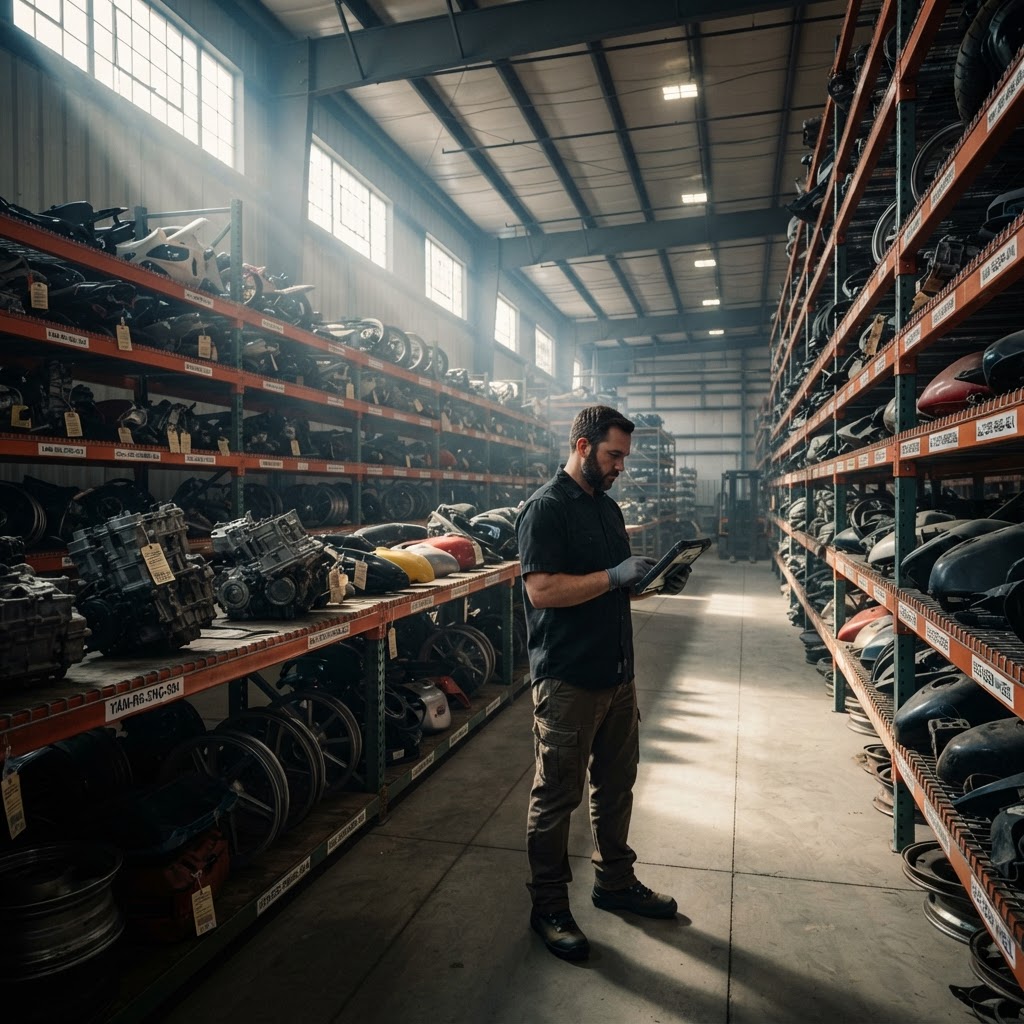
Walk into any amateur powersports salvage yard, and you will likely see a familiar, chaotic scene. Engines sit on the floor in pools of their own oil, fairings are stacked precariously in dusty corners, and buckets overflow with unlabelled bolts. If you ask the owner if they have a stator cover for a 2008 GSX-R600, they might scratch their head, walk over to a mountain of aluminum parts, and say, "I know it's in here somewhere."
In the modern ecommerce era, "somewhere" is not a viable business strategy. When you are selling on highly competitive platforms, your ability to locate, pick, and ship a part on the same day is the difference between a thriving business and a failing one. Dismantling a single motorcycle can yield anywhere from 100 to 300 individual sellable parts. When you scale that operation up to dismantling dozens of bikes a week, you are suddenly dealing with thousands of unique SKUs. Without a rock-solid system, this volume of inventory will quickly overwhelm you.
Professional dismantlers operate entirely differently. They view their warehouse not as a junkyard, but as a high-efficiency fulfillment center. Every bolt, bracket, transmission, and exhaust pipe has a dedicated, trackable home. This comprehensive guide will walk you through the exact strategies, workflows, and tools that industry-leading salvage operators use to master motorcycle parts inventory management and scale their operations to incredible heights.
The Anatomy of a Perfect Motorcycle Parts Inventory System
Before you turn a single wrench, you must have a logical, physical framework in place to store the parts you remove. The foundation of motorcycle parts inventory management is the "Bin Location" system. Your warehouse or garage must be mapped out on an alphanumeric grid, allowing any employee (or yourself) to walk directly to a part in seconds.
The Alphanumeric Grid System
A standard best practice for powersports salvage is the Zone-Aisle-Bay-Shelf-Bin model.
- Zone: Broad areas of your facility (e.g., Zone A for clean parts, Zone B for heavy/dirty parts).
- Aisle: The specific row of shelving (e.g., Aisle 01, Aisle 02).
- Bay: The vertical column of shelving within that aisle (e.g., Bay A, Bay B).
- Shelf: The specific horizontal shelf, usually numbered from bottom to top (e.g., Shelf 1, Shelf 2).
- Bin: The exact box or tote on that shelf (e.g., Bin 01, Bin 02).
Under this system, a part with the location code "A-02-B-3-01" tells you exactly where to go: Zone A, Aisle 2, Bay B, 3rd shelf up, 1st bin on the left. This eliminates all guesswork. Whether you are storing a tiny sensor or a massive V-twin engine case, its location is absolute.
Standardizing Your SKUs
Every part needs a unique Stock Keeping Unit (SKU). Many successful dismantlers build their SKUs using a combination of the donor bike's unique stock number and a sequential part number. For example, if you buy a 2010 Honda CBR1000RR and assign it Stock Number "1024", the first part you pull off it (maybe the mirrors) becomes SKU "1024-001". The engine might be "1024-050". This immediately tells you which donor bike the part originated from, making it much easier to trace fitment issues or verify the exact year and model later down the line.
Essential Dismantler Tools of the Trade
Transitioning from a hobbyist wrencher to a professional yard requires investing in the right dismantler tools. These tools bridge the gap between the physical teardown process and the digital listing process.
Physical Organization Tools
- Heavy-Duty Industrial Shelving: Powersports parts are incredibly dense. A single shelf might need to hold multiple cylinder heads, a crankcase, and a differential. Invest in pallet racking or heavy-duty rivet shelving.
- Standardized Poly Bags and Bins: Consistency is key. Use heavy-mil zip-top poly bags for hardware, sensors, and small brackets. Use durable, uniform plastic totes for medium-sized parts. When every bin is the same size, your shelves stay organized and maximizing space becomes a simple game of Tetris.
- Thermal Barcode Printers: Do not rely on masking tape and sharpies. A high-quality thermal printer (like a Zebra or Rollo) allows you to print durable, smudge-proof labels with barcodes. The moment a part is bagged, a label is slapped on it.
- UV Marking Pens: Unfortunately, return fraud is a reality in the used parts business. Buyers may order your good part, swap it with their broken one, and return the broken one to you. Always mark your parts with an invisible UV pen or custom tamper-evident stickers before shipping to verify authenticity upon return.
Digital Tools
- Mobile Devices/Tablets: Your teardown station should have a dedicated tablet or smartphone on an articulating arm. This allows the dismantler to take high-resolution photos of the part the moment it comes off the bike, while it is still well-lit and on the workbench.
- Digital Calipers and Multimeters: Accurately describing the condition of a part reduces returns. Use calipers to measure brake rotor thickness and multimeters to test stator resistance, capturing photos of these readings for your listings.
The Teardown Workflow: Breaking Down the Bike
The actual teardown process is where the most time is either saved or lost. Professional yards do not take a bike apart, pile the parts in a corner, and list them weeks later. They utilize a "One-Touch" or "List-As-You-Pull" workflow. The goal is to touch the part as few times as possible between removing it from the frame and shipping it to the customer.
Step-by-Step Teardown Process
- Vehicle Intake: The bike is assigned a stock number. You record the VIN, mileage, year, make, and model. You take photos and videos of the bike running (if possible) to prove to buyers that the engine and electrical components function.
- Fluid Drain and Prep: All gas, oil, coolant, and brake fluid are safely drained.
- Component Removal: The dismantler removes a part, such as a stator cover.
- Cleaning and Inspection: The part is quickly wiped down with a solvent and inspected for deep scratches, cracks, or stripped threads.
- Photography: The part is placed on a well-lit white backdrop right next to the teardown lift. The dismantler takes 4 to 6 clear photos showcasing all angles and any flaws.
- Instant Listing: Using a mobile device, the dismantler creates the inventory record immediately. This is where RevParts shines. With RevParts, you can snap the photos, draft the title, assign the SKU, and set the bin location right from your phone before the part even leaves the workbench.
- Bagging and Tagging: The part is placed in a poly bag (if applicable), the thermal label is printed and applied, and the part is placed in a designated "To Be Binned" cart.
By following this flow, by the time the bare frame is sitting on the floor, 100% of the sellable parts are already photographed, tagged, and ready to be pushed to your sales channels.
Leveraging Parts Management Software for Scale
If you are trying to manage thousands of SKUs using a basic Excel spreadsheet or a notebook, you are severely limiting your growth potential. Spreadsheets cannot automatically sync your inventory levels across multiple marketplaces, nor can they automatically un-list a part from your website when it sells on eBay.
This is why adopting dedicated parts management software is an absolute necessity for modern salvage operations. Purpose-built software acts as the central brain of your entire business.
When you use an integrated system like RevParts, you eliminate double-data entry. RevParts serves as both a powerful marketplace and a robust eBay Motors listing tool specifically designed for powersports sellers. Instead of logging into eBay to create a listing, then logging into a separate spreadsheet to track where you put the item, you do it all in one centralized hub.
Good software handles the complex nuances of the industry. It tracks costs (how much you paid for the donor bike), calculates profit margins per bike, manages shipping presets based on part weight, and ensures that when a part is sold, it is instantly removed from all active sales channels. This prevents the dreaded "double-selling" scenario that results in cancelled orders and damaged seller metrics.
Advanced Storage Solutions by Category
Not all motorcycle parts are created equal. A comprehensive motorcycle parts inventory management strategy requires different storage protocols for different categories of parts.
Body and Frame Components
Plastics, fairings, and frames take up massive amounts of space and are easily scratched.
- Storage Strategy: Fairings should be wrapped in light bubble wrap or foam sheeting and stored vertically on specialized racks with dividers, much like vinyl records. Frames should be hung from heavy-duty ceiling hooks or stored on dedicated vertical frame racks to save floor space.
- Real-World Example: Let's say you just pulled a pristine set of Brute Force 750 Body Hardware ($99.99). These small plastic rivets and brackets are easily lost. They should be immediately grouped into a heavy-duty poly bag, sealed, labelled, and stored in a small bin in your "Body/Frame" aisle, rather than tossed loosely into a drawer.
Transmission and Engine Components
These parts are heavy, oily, and prone to rust if left exposed to humid air.
- Storage Strategy: Engines should be stored on custom wooden pallets or heavy-duty engine stands on the lowest level of your pallet racking. Internal transmission gears and crankcases should be lightly coated in a rust-inhibitor spray (like WD-40 Specialist or Cosmoline), sealed in thick plastic bags, and stored in sturdy totes.
Exhaust Systems
Exhausts are awkwardly shaped, long, and easily dented.
- Storage Strategy: Store exhaust headers and mufflers on cantilever racks or deep vertical bins.
- Real-World Example: Consider a vintage 1988 Kawasaki KDX200 Spark Arrestor Muffler ($150). This is a highly sought-after vintage part. It needs to be carefully documented, wrapped in bubble wrap to protect the aluminum finish, and stored on a dedicated exhaust rack in the "Exhaust" zone so it isn't crushed by heavier metal parts.
Mini Case Study: Apex Powersports Salvage
To understand the true impact of proper motorcycle parts inventory management, let's look at a composite case study of a typical seller scaling up.
"Apex Powersports" started in a two-car garage. The owner, Dave, was buying two salvage bikes a month, tearing them down, and keeping the parts in cardboard boxes. When he had 200 parts, his memory was enough to find things. When he scaled up to leasing a 3,000 square-foot warehouse and buying 15 bikes a month, his system completely broke down.
Dave found himself spending three hours a day just looking for parts that had sold on eBay. Worse, he was frequently refunding customers because he had lost the part entirely or sold it locally the week prior and forgot to take the listing down. His seller rating plummeted.
Dave decided to pause buying bikes for two weeks to completely overhaul his system. He installed three aisles of standardized industrial shelving. He bought 500 uniform plastic bins. He then adopted RevParts to manage his workflow.
Dave went through his entire warehouse, bin by bin. He assigned every part a new SKU, placed it in a specific bin location, and scanned it into RevParts. Going forward, he utilized the "List-As-You-Pull" method. Because RevParts automatically managed his eBay Motors listings and synced his inventory in real-time, Dave's daily picking time dropped from three hours to just fifteen minutes. His "Item Not Found" cancellation rate dropped to absolute zero. By implementing professional dismantler tools and software, Apex Powersports doubled its monthly revenue without needing to hire additional warehouse staff.
Mastering Fitment and Cross-Compatibility
One of the most complex aspects of selling used motorcycle parts is dealing with cross-compatibility. Unlike many car parts, powersports manufacturers frequently use the exact same part across dozens of different models and years. A front brake master cylinder pulled from a 2012 Suzuki GSX-R600 might perfectly fit a 2015 GSX-R750, a 2009 SV650, and even certain Kawasaki models.
If you only list that master cylinder as fitting a 2012 GSX-R600, you are leaving massive amounts of money on the table by hiding your listing from thousands of potential buyers.
Professional parts management software solves this by integrating with robust fitment databases. When you list a part and input the OEM part number, the software should automatically populate the listing with the complete list of compatible years, makes, and models. This dramatically increases the visibility of your listings on search engines and marketplaces, ensuring your parts sell faster and for higher prices.
Maintaining Accuracy with Cycle Audits
Even with the best system in the world, human error happens. A part gets put back in the wrong bin, a label gets damaged, or an employee forgets to log a local cash sale. Over time, these small errors accumulate, leading to a phenomenon known as "inventory drift."
To combat this, professional salvage yards do not wait for an annual inventory count; they perform "Cycle Audits."
Cycle counting involves auditing a small, specific section of your warehouse on a continuous, rotating basis. For example, every Friday morning, your team might take 30 minutes to physically audit Aisle 1. They check every bin on that aisle against the active inventory list in your software. If a part is on the shelf but not in the software, it gets re-listed. If a part is in the software but missing from the shelf, the listing is immediately pulled to prevent a bad sale.
By auditing one aisle a week, you ensure that your entire warehouse is verified several times a year, catching and correcting errors before they impact your customers or your seller metrics.
Conclusion: The Path to Profitable Dismantling
Transitioning from a disorganized pile of parts to a streamlined, highly profitable fulfillment operation is entirely within your reach. It requires upfront discipline, a commitment to a standardized grid system, and the right investments in dismantler tools.
However, physical organization is only half the battle. To truly scale, you need a digital backbone that can handle the fast-paced, high-volume nature of powersports dismantling. You need a system that integrates your teardown bench directly with your sales channels, managing thousands of SKUs, fitment data, and bin locations flawlessly.
By leveraging advanced parts management software, you take the friction out of the selling process. You stop spending your days hunting for lost exhausts and start spending them sourcing more bikes, pulling more parts, and growing your bottom line.
Ready to start listing your parts? Sign up free at RevParts → https://revpartspro.com/become-seller
Stay in the loop
Get the latest powersports tips, new parts alerts, and seller guides — straight to your inbox. No spam.