Powersports Cross-Listing Software: Double Your Sales Reach
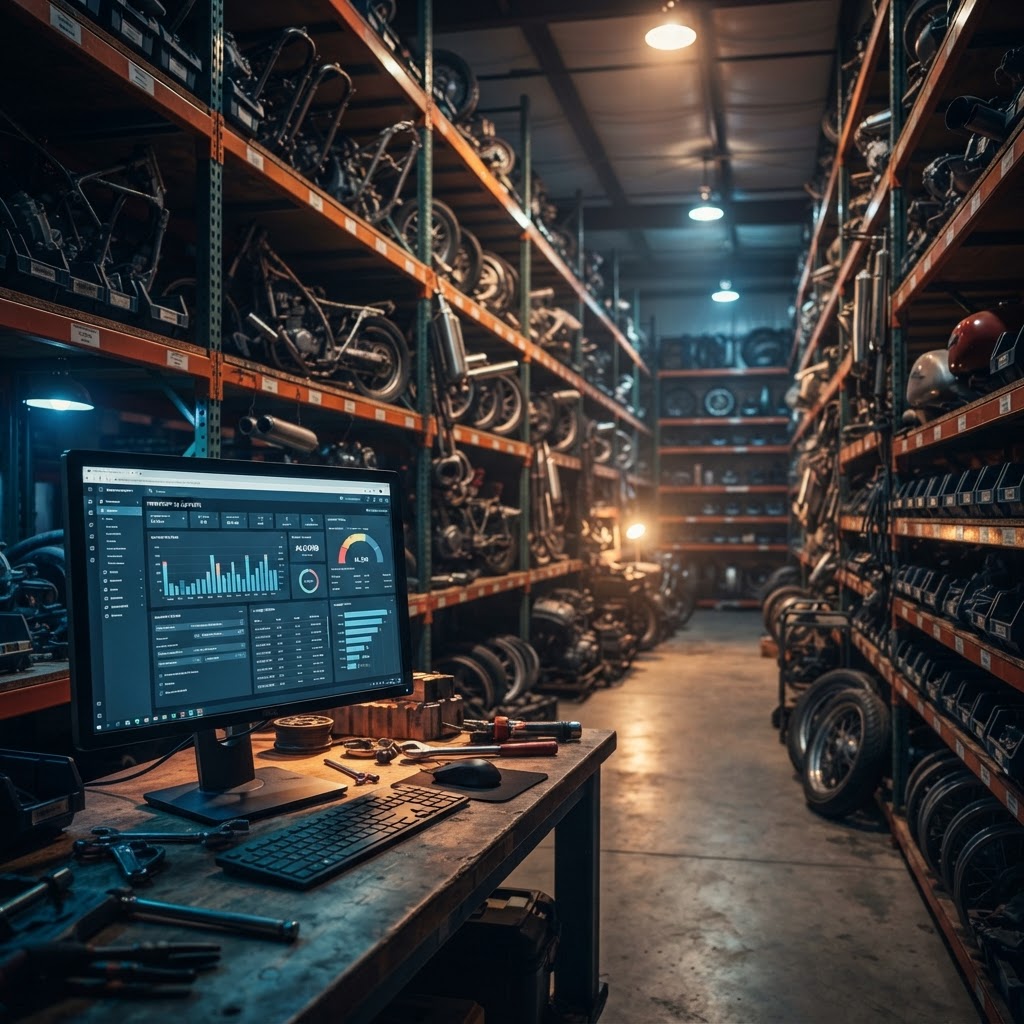
If you run a powersports salvage yard or dismantling business, you already know that the real work doesn't stop when the engine is finally pulled from a wrecked chassis. In fact, that is just the beginning of the journey. The actual bottleneck in your business isn't tearing down the wrecked ATVs, dirt bikes, or side-by-sides. The real challenge is getting those individual components cleaned, photographed, accurately priced, and placed in front of the right buyers. Every hour a perfectly good transmission or exhaust assembly sits on a warehouse shelf is an hour it isn't making you money. For years, dismantlers have relied on a single sales channel, painfully uploading listings one by one. But the industry has evolved, and the methods of the past are no longer sufficient for growth.
Today, the most successful sellers are leveraging specialized technology to put their inventory in front of millions of buyers simultaneously. If you want to move parts faster and clear out your warehouse, you need a system that works as hard as your teardown crew does. Enter powersports parts cross-listing software. By bridging the gap between niche marketplaces and massive platforms like eBay Motors, sellers are literally doubling their reach overnight without doubling their workload.
In this comprehensive guide, we are going to break down exactly how modern dismantling operations are utilizing these advanced digital tools to scale their businesses, reduce listing fatigue, and dominate the used parts market. From managing complex donor vehicles to syncing inventory across the web, you will learn how to turn your backlog of parts into a streamlined, revenue-generating machine.
The Hidden Cost of Manual Data Entry
Let's paint a familiar picture. You just finished breaking down a 2015 Kawasaki Brute Force 750. You have a pile of perfectly good parts categorized and ready to go: the transmission, body panels, exhaust, and assorted hardware. Now comes the most tedious part of the job. You sit down at a greasy computer terminal. You log into eBay. You manually type out the title, select the condition, write a detailed description, upload the photos, and figure out the shipping parameters.
Then, you realize you also want to list it on a specialized powersports site to catch the hardcore builders who might not be browsing eBay. So, you open a new tab, copy the title, copy the description, re-upload the same photos, and cross your fingers that you remember to take it down from one site when it sells on the other. This manual listing process is fundamentally broken for high-volume salvage sellers, and it is silently eating away at your profit margins.
The time drain is the most obvious issue. Entering the same data across multiple platforms doubles or triples your administrative time. If you pay an employee to list parts, you are paying them twice to do the exact same job. Furthermore, human error is inevitable. Copy-pasting constantly leads to mistakes. A typo in a part number or a mismatched fitment year can mean a lost sale or, worse, a frustrated customer processing a return for an item that didn't fit their bike.
Most dangerously, manual entry causes inventory discrepancies. If a part sells on one platform and you forget to manually delist it from another, you risk selling an item you no longer have in stock. This leads to canceled orders, negative feedback, and severely damaged account health on strict platforms like eBay. Your staff's time is much better spent pulling parts, testing components, and shipping orders, not doing repetitive data entry.
Understanding Powersports Parts Cross-Listing Software
So, what is the solution to the manual listing madness? The answer lies in purpose-built cross-listing software. Unlike generic retail inventory tools that try to be everything for everyone (like those built for dropshippers or boutique clothing stores), a dedicated powersports listing tool understands the unique nuances of salvage parts. It knows that a left-side fairing needs specific year, make, and model fitment data. It knows that a stator or a carburetor requires specific condition grading and donor vehicle tracking.
At its core, a cross-listing platform acts as your central command center. You create the listing exactly once. You upload your high-resolution photos, set your price, write your description, and define the shipping parameters in one unified dashboard. The software then automatically pushes that single listing out to multiple integrated marketplaces simultaneously.
When you utilize an eBay listing tool powersports sellers specifically rely on, you gain access to a massive global audience without the usual backend headaches. eBay Motors is an absolute behemoth in the used auto and powersports parts industry, but its native interface can be incredibly clunky for bulk listers who are processing dozens of unique items a day. A specialized tool streamlines the eBay process, automatically formatting descriptions to look professional, applying the correct category tags, and managing complex fitment compatibility charts.
But the real magic happens when you combine eBay's massive, generalized reach with a specialized marketplace. By pushing your inventory to both general and niche audiences simultaneously, you maximize your chances of a quick sale at your asking price.
Why You Need Both eBay Motors and a Niche Marketplace
Many sellers ask, "If eBay Motors is so big, why do I need to list my parts anywhere else?" It is a fair question, but it misses a fundamental truth about modern e-commerce: buyer intent varies significantly by platform. Relying on a single platform is essentially putting all your business eggs in one digital basket.
The eBay Motors Advantage
eBay Motors is the world's largest digital swap meet. It brings sheer volume and unmatched search engine authority. Millions of buyers search eBay daily for everything from a vintage 1988 Kawasaki KDX200 Spark Arrestor Muffler to a complete, modern UTV engine swap. The primary advantage here is exposure. If someone is blindly Googling a specific part number, eBay's massive SEO budget ensures your listing will likely pop up at the top of the search results. It is the ultimate platform for capturing general, wide-net traffic.
The Specialized Marketplace Advantage
However, eBay has high final value fees, strict seller metrics, and a sea of cheap, aftermarket knock-off parts that can often drown out your high-quality OEM salvage items. This is exactly where a dedicated marketplace shines. Buyers who visit a specialized powersports platform are usually professional builders, independent repair shops, or passionate enthusiasts. They aren't looking for cheap Chinese plastics that will break in a week; they want authentic, tested, used OEM parts that they know will fit their machine perfectly.
When you use cross-listing software to push your inventory to both platforms simultaneously, you get the absolute best of both worlds. You capture the massive, search-engine-driven traffic of eBay Motors while also tapping into a concentrated, high-intent audience on a specialized site. This dual-channel approach is exactly how top sellers are doubling their reach and moving their inventory twice as fast as the competition.
Master Your Workflow with RevParts Inventory Management
To successfully pull off this multi-channel strategy, you need a robust, reliable backend. This is where RevParts inventory management completely changes the game for dismantlers. RevParts isn't just a marketplace; it is a comprehensive ecosystem designed specifically for the daily realities of powersports salvage yards.
Retail inventory software assumes you have 100 identical items with the exact same barcode. Salvage is the exact opposite. You have one unique item, with its own specific wear and tear, pulled from a specific donor vehicle. RevParts inventory management is built entirely around this donor vehicle concept. When you tear down a wrecked bike, you can tag all subsequent parts to that specific VIN or stock number, keeping a perfect chain of custody and data integrity.
Let's look at how RevParts handles specific inventory categories like Body/Frame, Transmission, and Exhaust:
- Body/Frame: When you list something like Brute Force 750 Body Hardware for $99.99, the system intuitively knows how to categorize the nuts, bolts, brackets, and plastics. You can easily specify the condition (e.g., minor scratches, no cracks) and immediately push it to both the RevParts marketplace and eBay Motors with a single click.
- Exhaust: Got a rare, vintage piece like a 1988 Kawasaki KDX200 Spark Arrestor Muffler listed at $150? Vintage parts require excellent photos and detailed descriptions of any rust, dents, or carbon buildup. The cross-listing tool ensures your high-resolution photos and meticulous notes are perfectly synced across all channels, protecting you from frustrating "item not as described" claims.
- Transmission: Gearboxes, crankcases, and clutch assemblies are high-ticket, mechanically complex items. Buyers need absolute confidence before dropping hundreds of dollars. Using RevParts as your central hub allows you to embed detailed testing notes, mileage verifications, and even links to videos of the engine running before teardown. This vital information is syndicated effortlessly to eBay.
By centralizing your operations within RevParts, you completely eliminate double data entry. You list the part once, tag its bin location so your warehouse guys can find it later, and the software does the heavy lifting, instantly expanding your digital footprint and managing your stock levels in real-time.
Mini Case Study: Turning a Graveyard into a Goldmine
To truly understand the impact of powersports parts cross-listing software, let's look at a real-world scenario. Meet "Apex Salvage," a mid-sized ATV and motorcycle dismantling operation located in the Midwest.
The Challenge
A year ago, Apex Salvage was struggling. Their outdoor yard was full of late-model side-by-sides and sport bikes waiting to be processed, but their cash flow was tied up in unlisted indoor inventory. The owner, Mark, employed two guys just to list parts on eBay. Despite their best efforts, typing out every listing meant they could only process about 30 to 40 parts a day. Meanwhile, the teardown crew was processing vehicles that generated 100+ sellable parts each. The backlog was growing rapidly, and perfectly good parts in high-demand categories like Transmission and Exhaust were sitting on shelves collecting dust instead of generating cash.
The Solution
Mark decided it was time to modernize his operations. He implemented a dedicated eBay listing tool powersports sellers recommended, choosing to completely switch his backend to the RevParts platform.
Here is what changed overnight:
- Single Point of Entry: Instead of logging into multiple sites and managing chaotic spreadsheets, Mark's team began entering every single part into the central RevParts dashboard.
- Instant Cross-Listing: A newly pulled stator or fairing was photographed, priced, and instantly pushed to both eBay Motors and the RevParts marketplace simultaneously.
- Automated Syncing: When a buyer purchased a rear shock on eBay at 2:00 AM, the software automatically delisted it from the other marketplace by 2:01 AM. There was absolutely zero risk of overselling.
The Results
Within 90 days, Apex Salvage saw a massive transformation. Their daily listing output jumped from 35 parts to over 90 parts per day with the exact same staff. Because their inventory was now visible on two massive channels instead of one, their monthly gross sales increased by 115%. Parts that had sat in the Body/Frame aisle for months were suddenly moving because they were finally getting the right exposure. The software didn't just save them time; it fundamentally scaled their revenue and cleared their backlog.
Overcoming the Challenges of Multi-Channel Fulfillment
Generating sales on multiple platforms is an incredible feeling, but it does introduce a new operational challenge: fulfilling those orders efficiently. When you are selling a massive engine block on eBay and a tiny bag of fairing bolts on a niche marketplace, your shipping processes need to be air-tight.
Using a centralized software system solves the fulfillment puzzle by aggregating all your orders into one unified dashboard. You don't have to log into eBay to print one label, and then log into a different site to print another. Everything flows into one queue. This allows your shipping department to bulk-print pick lists and shipping labels, dramatically speeding up your daily dispatch routine.
Furthermore, specialized inventory tools allow you to store package weights and dimensions at the time of listing. When that 1988 Kawasaki KDX200 Spark Arrestor Muffler sells, the system already knows it weighs 4 pounds and fits in a specific box. The shipping label is practically ready to print the second the buyer's payment clears. This level of organization prevents the frantic end-of-day scramble that plagues so many salvage yards.
Finally, the software automatically pushes tracking numbers back to the respective marketplaces. The buyer gets their notification, the marketplace marks the item as shipped, and your seller metrics remain in perfect standing, all without you having to manually copy and paste a single tracking digit.
Maximizing Profit Margins with Smart Pricing Strategies
When you double your reach using cross-listing software, you also gain the ability to be much more strategic with your pricing. Selling on multiple platforms means you can adjust your prices dynamically based on the fee structures and audience behaviors of each specific marketplace.
Platform-Specific Pricing
For example, eBay Motors charges final value fees that can take a noticeable bite out of your margins, especially on heavy or high-ticket items where shipping is also expensive. With an intelligent cross-listing tool, you can set an automated rule to mark up your eBay listings by 10% to 15% to comfortably cover those marketplace fees. Meanwhile, you can list the exact same part on a specialized marketplace (where seller fees are often much lower) at a more competitive, baseline price.
Let's take our earlier example: the Brute Force 750 Body Hardware. You might list it for $115 on eBay to cover the marketplace fees and potential promoted listing costs, but offer it for the standard $99.99 on your specialized powersports channel. This pricing strategy ensures you maintain your desired profit margin regardless of where the buyer ultimately checks out.
Avoiding the Race to the Bottom
Because your inventory is now visible to a much larger audience across multiple channels, you no longer have to rely on being the absolute cheapest option to secure a sale. Buyers will gladly pay a premium for OEM used parts that are clearly photographed, accurately described, and backed by a professional, highly-rated seller. RevParts inventory management allows you to highlight the exact condition, donor vehicle mileage, and testing results, giving you the solid justification to hold your price and maximize your return on every single teardown.
Step-by-Step: How to Start Cross-Listing Today
If you are ready to modernize your salvage operation, clear out your backlog, and stop leaving money on the table, transitioning to cross-listing software is easier than you might think. Here is an actionable, step-by-step guide to getting your yard up and running on a multi-channel strategy.
Step 1: Audit Your Current Inventory
Before migrating to any new system, take stock of what you currently have listed and what is sitting on your shelves. Identify which items are moving and which are stagnant. Clean up your physical bin locations so that your new digital inventory will perfectly match your physical reality. A clean slate makes for a smooth software transition.
Step 2: Choose the Right Software
Don't settle for generic retail tools. You need software explicitly tailored to the powersports salvage industry. Look for platforms that offer robust RevParts inventory management features, allowing you to easily track donor vehicles, manage complex bin locations, and handle the specific fitment data required for motorcycles, ATVs, and UTVs.
Step 3: Connect Your eBay Motors Account
A quality tool will feature a seamless API integration with eBay. You will simply log into your eBay account through the software's dashboard, grant the necessary permissions, and let the systems sync. This crucial connection is what transforms the software into a powerful eBay listing tool powersports buyers rely on to discover your parts.
Step 4: Standardize Your Photography Setup
Because you will be listing significantly faster, you need a photography workflow that can keep pace. Set up a dedicated photo booth in a clean corner of your warehouse with bright, even LED lighting and a neutral, uncluttered background. Take photos from standard angles for every part. Visual consistency builds buyer trust and drastically speeds up the listing process.
Step 5: List, Sync, and Ship
Start listing your new teardowns through the centralized software dashboard. Watch as your items automatically populate across multiple marketplaces instantly. As the orders start rolling in, manage all your shipping, tracking uploads, and customer communication from one streamlined location.
The Future of Powersports Salvage is Connected
The days of relying on a single marketplace and manual data entry are officially over. The powersports salvage industry is becoming increasingly competitive, and the sellers who thrive over the next decade will be the ones who adopt modern technology to streamline their daily operations. By utilizing powersports parts cross-listing software, you instantly double your reach, eliminate tedious double-entry, protect your seller ratings from out-of-stock cancellations, and most importantly, free up your time to focus on what you do best: sourcing and tearing down more inventory.
Whether you are moving a $99.99 Brute Force 750 Body Hardware set, a rare vintage exhaust, or a complete modern engine swap, your high-quality parts deserve to be seen by every potential buyer on the internet. Leveraging a specialized tool not only makes you a far better, more efficient seller on eBay Motors, but it simultaneously opens the door to dedicated communities of builders and riders actively searching for exactly what you have on your shelves.
Ready to start listing your parts? Sign up free at RevParts → https://revpartspro.com/become-seller
Stay in the loop
Get the latest powersports tips, new parts alerts, and seller guides — straight to your inbox. No spam.