How to Price Used ATV and Motorcycle Parts for Maximum Profit
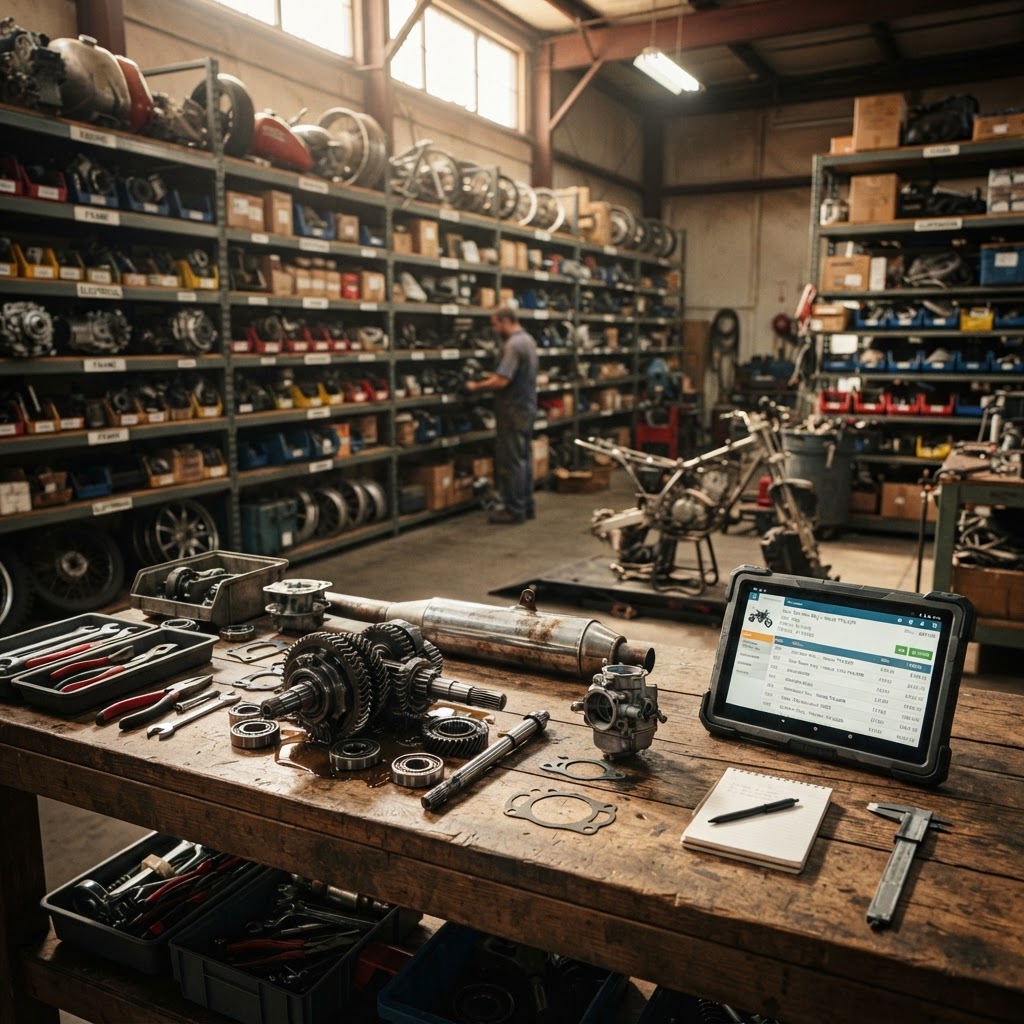
As a powersports dismantler, there is nothing quite like the satisfaction of tearing down a wrecked motorcycle or a worn-out ATV. Your hands are covered in grease, the air compressor is humming in the background, and you are methodically turning a non-running machine into a highly profitable inventory of parts. You know how to wrench. You know how to spot a bent frame, diagnose a blown stator, or salvage a pristine transmission. But when the tools go back in the box and you sit down at your computer, you face the real, most intimidating challenge of the salvage business: figuring out exactly how to price used parts.
Pricing used ATV and motorcycle parts for maximum profit is an art form backed by hard data. If you price your inventory too high, your shelves will gather dust, your storage space will vanish, and your cash flow will grind to an agonizing halt. Price your inventory too low, and you are leaving thousands of dollars of hard-earned profit on the table for flippers and your competitors to swoop up. In the highly competitive, fast-paced world of eBay Motors and online powersports marketplaces, hitting that pricing sweet spot is the exact difference between a struggling side hustle and a massive, scalable salvage operation.
Fortunately, you no longer have to guess. The era of blindly pricing a swingarm or an exhaust header based on a gut feeling is over. Today, successful dismantlers rely on proven market research, historical sales data, and powerful inventory management systems. In this comprehensive, deep-dive guide, we will break down the exact strategies you need to master ATV parts pricing, execute accurate motorcycle parts valuation, and turn your salvage yard into a highly efficient, profit-generating machine. Whether you are parting out your first dirt bike or managing a warehouse with ten thousand active SKUs, these proven principles will elevate your bottom line.
The Core Philosophy of Motorcycle Parts Valuation
Before you can effectively price used parts, you must understand the underlying philosophy of motorcycle parts valuation. Many amateur sellers make the critical mistake of looking up the Manufacturer's Suggested Retail Price (MSRP) of a brand-new Original Equipment Manufacturer (OEM) part and simply slashing it by 50 percent. While that rudimentary rule of thumb might have worked a decade ago in local classifieds, the modern digital marketplace is infinitely more dynamic. Valuation today is driven strictly by supply, demand, availability, and the specific needs of the buyer.
Motorcycle parts valuation requires you to understand the buyer's mindset. When a customer is looking for a used part, they are generally motivated by one of three things. First, they want to save money compared to buying new from a dealership. Second, the part they need has been discontinued by the manufacturer and is no longer available anywhere else. Third, they need the part immediately and cannot afford to wait for a backordered item from an overseas factory. Understanding which of these three categories your specific part falls into is the first step in maximizing your profit.
For example, if you are selling a generic, widely available brake caliper for a modern sportbike, you are competing strictly on price and condition against dozens of other sellers. However, if you possess a rare, discontinued component for a vintage machine, the standard pricing rules no longer apply. In those scenarios, motorcycle parts valuation becomes a seller's market, and you can often command prices that approach or even exceed the original retail value of the part. This is why standardizing your approach to pricing based on market data rather than arbitrary percentages is absolutely crucial for your business's survival.
Market Research: How to Price Used Parts Accurately
The foundation of how to price used parts lies in meticulous market research. You cannot price a part in a vacuum. The most powerful tool at your disposal for determining fair market value is analyzing historical sales data. Many sellers make the amateur mistake of searching for a part on eBay and pricing their item based on what is currently listed. Active listings do not represent what a part is worth; they only represent what another seller hopes to get for it. To find the true market value, you must look strictly at sold and completed listings.
When conducting your market research, filter your searches to show only items that have successfully sold within the last 90 days. Pay close attention to the median sale price, but also look at the outliers. Why did one specific stator sell for $150 while three others sold for $85? Was it in exceptionally better condition? Did it include the mounting hardware or the corresponding voltage regulator? Did it offer free expedited shipping? Analyzing these small details will help you position your own listings at the top of the market rather than racing to the bottom.
This is where having the right software infrastructure changes the game. When you utilize a powerful powersports salvage parts marketplace and eBay Motors listing tool like RevParts, you gain an immediate edge over the competition. RevParts is designed specifically for the unique needs of salvage dismantlers, allowing you to streamline this research phase. Instead of keeping messy spreadsheets and manually tracking market fluctuations, modern sellers use intelligent inventory systems to manage their pricing matrices effectively.
The Pricing Matrix: Condition, Rarity, and Seasonality
Effective ATV parts pricing and motorcycle parts valuation require you to build a internal pricing matrix based on three core pillars: Condition, Rarity, and Seasonality. By evaluating every component against these three factors, you ensure that you are never leaving money on the table.
Condition Grading
Condition is king in the salvage business. You should implement a strict internal grading scale (such as Grade A, B, and C) for your inventory. Grade A parts are essentially pristine—they show minimal wear, have no deep scratches, and function perfectly. These can be priced at the absolute top of the historical market data. Grade B parts show typical wear and tear for their age but are fully functional and structurally sound. These represent the bulk of your inventory and should be priced competitively at the market average. Grade C parts are damaged, heavily scratched, or require repair before use. These must be priced aggressively below market value to move them out of your warehouse.
Rarity and Vintage Items
Rarity is the ultimate multiplier in motorcycle parts valuation. Discontinued parts for highly sought-after vintage bikes operate in their own economic reality. Take exhaust systems, for example. We recently saw a 1988 Kawasaki KDX200 Spark Arrestor Muffler move easily for $150. To an untrained eye, a 30-year-old muffler might look like scrap metal. But because vintage two-stroke enduro parts are incredibly scarce and highly prized by restoration enthusiasts, a solid, unrusted exhaust component commands a massive premium. Always check to see if an OEM part is marked as "discontinued" or "NLA" (No Longer Available) by the manufacturer. If it is, immediately bump your asking price.
Seasonality
Seasonality heavily impacts ATV parts pricing. If you are dismantling a snowmobile or a utility ATV equipped with a snow plow mount, the value of those parts skyrockets in October and November as buyers prepare for winter. Conversely, parts for high-performance personal watercraft (PWC) or summer trail dirt bikes hit peak valuation in the spring. Smart dismantlers adjust their pricing based on the calendar. If you tear down a snowmobile in June, you might choose to price the parts slightly higher and let them sit in inventory until the first freeze drives desperate buyers to your listings.
Strategies for ATV Parts Pricing by Category
Not all parts are created equal, and your strategy on how to price used parts must adapt depending on the category of the item you are listing. Let's break down the optimal pricing strategies for three of the most active RevParts categories: Body/Frame, Transmission, and Exhaust.
Body/Frame Components
Body and frame components represent the outer shell of the vehicle and are highly susceptible to damage during crashes. When cataloging Body/Frame components in RevParts, you have to think like a rebuilder. A perfect set of OEM plastics commands top dollar, but don't ignore the small stuff. For instance, you might bundle a set of Brute Force 750 Body Hardware and price it at $99.99. Pricing hardware kits at this level is incredibly strategic because OEM bolts, brackets, and grommets are notoriously expensive to buy individually from a dealer. Rebuilders who have lost their hardware during a teardown will gladly pay nearly $100 for a complete, guaranteed-to-fit bucket of original bolts.
Transmission and Engine Internals
Transmission and engine internals are the lifeblood of powersports salvage. Complete running engines are great, but parting out a blown engine can often yield higher total profits. Transmission gears, shift forks, primary shafts, and clutch baskets hold tremendous value. When setting your ATV parts pricing for transmission components, guarantee the condition. A buyer purchasing a used transmission gear is taking a massive risk; if the gear has chipped teeth, it will destroy their engine rebuild. Take high-resolution photos of the gear teeth and clearly state that the part has been visually inspected for stress fractures. Parts with a strong condition guarantee can be priced 15% to 20% higher than listings with blurry photos and vague descriptions.
Exhaust Systems
Exhaust systems are highly dependent on cosmetics and structural integrity. As mentioned with the 1988 Kawasaki KDX200 Spark Arrestor Muffler ($150), age and rarity play a big role. However, for modern bikes, buyers are looking for undamaged, rust-free headers and dent-free slip-ons. When pricing exhaust parts, carefully inspect for rust-through holes, loose interior baffles, and deep road-rash from crashes. A pristine titanium exhaust header from a modern motocross bike can often fetch 60% to 70% of its new retail price, while a dented or rusted steel header might only be worth its weight in scrap. Always photograph the underside of the exhaust, as that is where the hidden damage usually lies.
Pricing Psychology and Offer Strategies on eBay
Once you have determined the raw monetary value of a part, you must apply pricing psychology to finalize your listing. RevParts, a dedicated powersports salvage parts marketplace and eBay Motors listing tool, automates this integration, but you still need to understand the human element behind the purchase.
The debate between Buy It Now (BIN) and Auction formats has been settled for years: Buy It Now is the undisputed king for parts dismantlers. When a rider breaks their ATV on a Saturday, they do not want to wait seven days for an auction to end; they want to buy the part instantly so they can ride the following weekend. Use Buy It Now exclusively, and utilize the psychological pricing trick of ending your prices in .99 or .95. A part priced at $199.99 feels significantly cheaper to a buyer than a part priced at $200.00.
Furthermore, you should strategically utilize the "Best Offer" feature. Many sellers build a 10% to 15% negotiation buffer into their initial ATV parts pricing. If your market research indicates a part is worth $100, price it at $114.99 and turn on Best Offer with an automatic auto-accept threshold set at $95, and an auto-decline set at $80. This gives the buyer the psychological thrill of negotiating a "deal" while ensuring you hit your target profit margin without having to manually respond to lowball messages.
Finally, consider the shipping illusion. Buyers strongly prefer "Free Shipping," even if the cost of shipping is baked into the price of the item. For lightweight items under two pounds (like stators, CDI boxes, and small hardware), roll the $8 to $12 shipping cost into your asking price and offer Free Shipping to boost your search rankings. For large, heavy items (like frames, engines, and heavy exhaust systems), use calculated shipping to protect yourself from exorbitant freight costs if the buyer lives across the country.
Mini Case Study: Turning a Wrecked Brute Force into Maximum Profit
To see these concepts in action, let's examine a mini case study. Imagine you purchase a wrecked Kawasaki Brute Force 750 from a local salvage auction for $800. The engine has a blown bottom end, and the front plastics are completely shattered. An amateur buyer might view this machine as a total loss, but a professional dismantler sees a goldmine waiting to be extracted.
First, you strip the Body/Frame components. Even though the front plastics are trashed, the underlying brackets, bolts, and mounting hardware are perfectly intact. You bundle these together into a comprehensive Brute Force 750 Body Hardware kit. By checking recent sales data and understanding the needs of rebuilders, you successfully price used parts like this hardware kit at $99.99. You just recouped over 12% of your initial investment from a bucket of bolts.
Next, you tear into the blown engine. The bottom end is destroyed, meaning a complete engine sale is impossible. However, the top end is in great shape, and the transmission gears survived the carnage. You meticulously clean and inspect the cylinder heads, pricing them at $250 each based on solid market research. You extract the transmission shafts and gears, inspecting the dogs for wear, and price the complete transmission assembly at $350. You pull the pristine throttle body and price it at $175.
Within just those few components, you have generated over $1,100 in listing value, completely covering the cost of the machine and putting you into pure profit territory. You still have the frame, the suspension components, the differential, the electronics, and the exhaust system left to list. By applying strict motorcycle parts valuation principles, ignoring the broken pieces, and strategically pricing the salvageable components, that $800 wreck can easily yield $2,500 to $3,500 in total revenue over a 12-month period.
Avoiding Common Pricing Pitfalls
Even with a solid understanding of how to price used parts, dismantlers can still fall into a few common traps. The most dangerous trap is "racing to the bottom." When you see a competitor drop their price on a matching part, the immediate instinct is to undercut them by five dollars. Do not do this. If your part is clean, well-photographed, and accurately described, hold your ground. The competitor's part will sell first, removing them from the market, and the next buyer in line will purchase yours at your desired profit margin. Racing to the bottom devalues the entire salvage market and destroys your margins.
Another major pitfall is overvaluing emotional attachment or initial investment. If you overpaid for a salvage bike, you cannot simply increase your parts prices to make up the difference. The market does not care what you paid for the wrecked motorcycle; the market only cares what the isolated parts are worth. If you made a bad buy at the auction, take your lumps, price the parts accurately to liquidate the inventory, and use the cash flow to make a smarter purchase next time.
Lastly, failing to utilize cross-compatibility data is the biggest missed opportunity in powersports salvage. A stator might be pulled from a 2008 Yamaha R6, but that exact same part number might fit the R6 from 2006 all the way to 2016. If you only list it as a 2008 part, you are artificially shrinking your buyer pool by 90%. By leveraging the extensive fitment data integration in RevParts, you guarantee that your listing shows up for every single compatible year and model. This dramatically increases visibility, speeds up your sell-through rate, and allows you to command higher prices because you are reaching a massive audience.
Conclusion: Mastering the Art of Parts Pricing
Figuring out exactly how to price used parts is the cornerstone of a lucrative powersports salvage operation. It requires a delicate balance of market research, strict condition grading, psychological pricing strategies, and an understanding of the unique variables like rarity and seasonality. By shifting your mindset from guessing to data-driven motorcycle parts valuation, you protect your profit margins and ensure a rapid turnover of your inventory.
The days of managing a salvage yard with a notepad and a gut feeling are long gone. To thrive in the modern era of eBay Motors and online marketplaces, you need professional tools designed specifically for the rigorous demands of dismantling. Using the automated inventory tools within RevParts, dismantlers can track their listings, manage cross-compatibility fitment, and push their inventory across multiple platforms seamlessly.
Ready to start listing your parts? Sign up free at RevParts → https://revpartspro.com/become-seller
Stay in the loop
Get the latest powersports tips, new parts alerts, and seller guides — straight to your inbox. No spam.