Start a Powersports Parts Business: Year One Guide
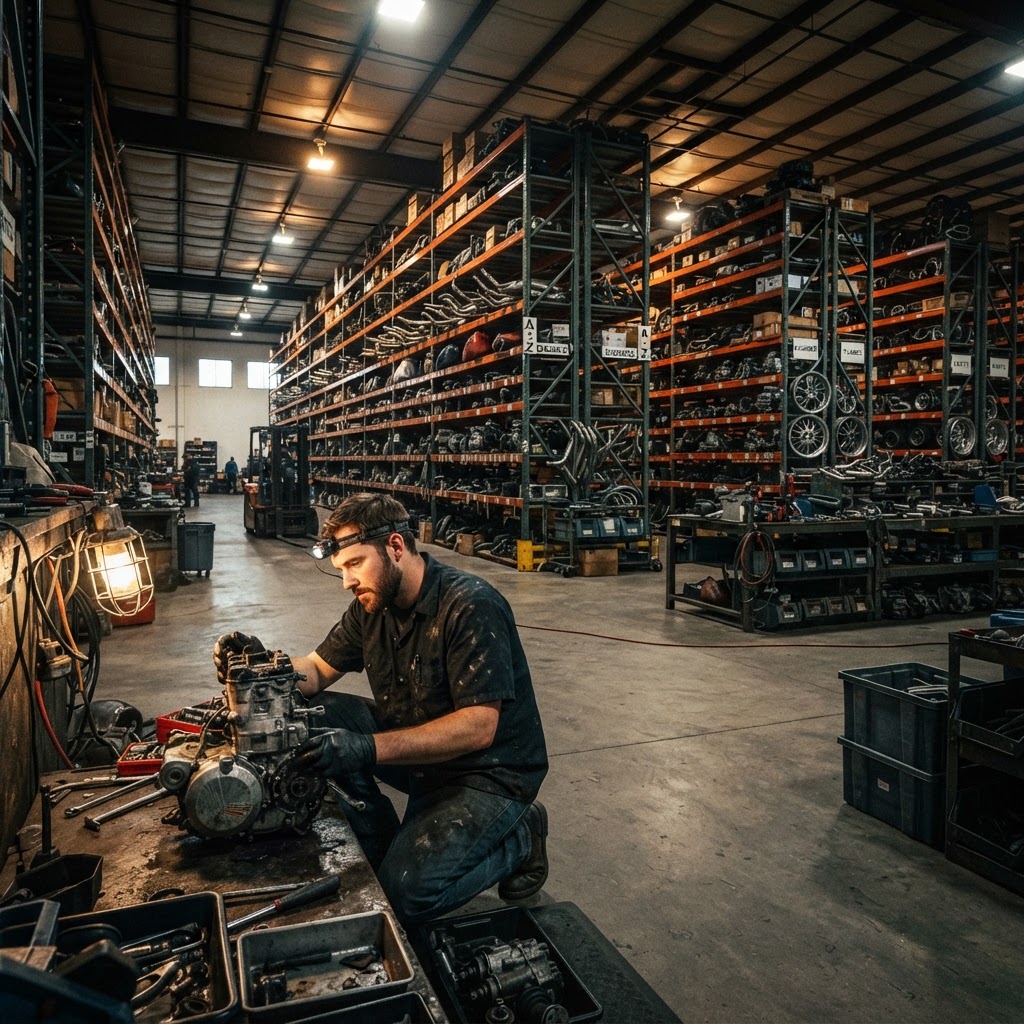
There is something undeniably satisfying about turning a wrench, breaking down a neglected machine, and finding immense value where others see only scrap metal. For many enthusiasts, the dream is to turn that passion into a full-time, profitable enterprise. If you are looking to start a powersports parts business, you are entering an industry with massive potential, dedicated buyers, and excellent profit margins.
However, turning a hobbyist garage into a highly efficient motorcycle parts business requires more than just a set of socket wrenches and a vague idea of what a carburetor is worth. The transition from parting out a single wrecked bike to running a fully operational e-commerce dismantler operation is steep. In your first year, you will face hurdles ranging from sourcing profitable inventory to navigating the complexities of online marketplaces.
This comprehensive guide will walk you through exactly what you need in year one to build a thriving salvage yard startup. We will cover the foundational legal requirements, advanced sourcing strategies, teardown efficiency, e-commerce optimization, and how utilizing the right tools—like RevParts—can turn a chaotic pile of metal into a streamlined, automated revenue machine.
1. Laying the Foundation for Your Salvage Yard Startup
Before you buy your first trailer load of wrecked motorcycles, ATVs, or side-by-sides, you need to establish a solid business foundation. Many eager entrepreneurs skip this step, only to face massive fines or operational roadblocks months down the line.
Legal and Zoning Requirements
Running a motorcycle parts business is vastly different from selling a few old parts out of your shed. Depending on your state, county, and city, you will likely need specific licenses to operate legally.
- Dismantler or Salvage License: Most states require a specific salvage or automotive dismantler license if you are parting out more than a handful of vehicles per year. This prevents title jumping and helps combat vehicle theft.
- Zoning Laws: You cannot typically operate a commercial salvage yard startup in a residential neighborhood. You will need a commercial or industrial-zoned property.
- Environmental Regulations: Powersports vehicles are full of hazardous fluids—oil, coolant, brake fluid, and gasoline. Your facility must be equipped to capture, store, and dispose of these fluids according to EPA and local environmental regulations.
Space and Facility Setup
In year one, space is your most valuable commodity. A 1,500-square-foot warehouse might seem massive when it is empty, but it will shrink rapidly once you introduce five dismantled ATVs and a dozen street bikes.
You need dedicated zones within your shop:
- Receiving and Holding: Where complete bikes wait for their turn on the lift.
- The Teardown Bay: Equipped with a lift, pneumatic/electric tools, fluid catch basins, and heavy-duty workbenches.
- The Wash Station: A specialized parts washer and ultrasonic cleaner to remove decades of grease and dirt.
- The Photography Studio: A well-lit, clean area dedicated solely to taking e-commerce photos.
- The Inventory Racks: High-density, industrial shelving organized by SKU and location codes.
- Shipping and Fulfillment: An area stocked with boxes, bubble wrap, scales, and label printers.
2. Sourcing Inventory: Buying the Right Machines
To successfully start a powersports parts business, you have to buy right. You make your money when you buy the bike, not when you sell the parts. If you overpay for inventory, your margins will evaporate.
Where to Find Inventory
In your first year, you should exhaust multiple sourcing channels:
- Salvage Auctions: Platforms like Copart and IAAI are the bread and butter of any salvage yard startup. You will bid on insurance write-offs, flood-damaged vehicles, and recovered thefts.
- Local Classifieds: Facebook Marketplace, Craigslist, and OfferUp are goldmines for non-running project bikes that owners have given up on.
- Tow Yards and Impound Lots: Build relationships with local towing companies. They frequently possess abandoned motorcycles that they need to liquidate to recover towing and storage fees.
- Dealership Trade-Ins: Sometimes, powersports dealerships take in older, heavily worn machines that are not worth reconditioning for their showroom floor. Offer to buy these outright.
Calculating the Multiplier
The golden rule of the motorcycle parts business is the "Multiplier." You should aim to extract at least 3x to 5x your purchase price in gross parts value.
If you buy a wrecked 2010 Yamaha R6 for $1,000, you need to confidently identify at least $3,000 to $5,000 in sellable parts. This margin absorbs your overhead, labor, marketplace fees, and the inevitable "dud" parts that never sell. Always focus on high-value components first: clean frames with titles, complete engines, suspension forks, and electronics (ECUs and wire harnesses).
3. The Teardown Process: Speed and Efficiency
Once you have a bike in the shop, the clock is ticking. Your profitability is directly tied to how quickly and carefully you can reduce a complete motorcycle into a catalog of individual components.
Pre-Teardown Testing
Never tear down a bike without testing it first. Buyers need to know if a part functions.
- Compression and Leak-Down Tests: Always document engine health before removing it from the frame.
- Electrical Testing: Video the gauge cluster lighting up, the turn signals blinking, and the starter turning over.
- Video Documentation: Recording a quick video of a running engine adds immense value to your eventual listing. Buyers will pay a premium for a motor they can hear running.
Strategic Dismantling
Develop a standardized teardown checklist. Start by draining all fluids. Next, remove the easily damaged exterior plastics, fuel tank, and seat. Then, systematically pull the exhaust systems, wiring harnesses, suspension, and finally, drop the engine.
During this phase, keep a keen eye out for valuable sub-components. Categories like Transmission and Exhaust are massive revenue drivers. A complete dirt bike transmission or a vintage OEM exhaust pipe can often fund the entire purchase price of the donor bike.
4. Organization and Cataloging: Preventing E-Commerce Chaos
The fastest way to fail in the motorcycle parts business is to lose track of your inventory. A disorganized shop leads to sold items you cannot find, canceled orders, negative feedback, and ultimately, suspended seller accounts.
The SKU and Bin System
Every single part must be assigned a unique SKU (Stock Keeping Unit) the moment it is cleaned and photographed.
You need a rigid storage system. Use heavy-duty plastic bins for small items (bolts, brackets, relays) and sturdy industrial shelving for heavy items (engines, wheels, frame swings). Your location codes should be alphanumeric, such as "A-04-02" (Aisle A, Rack 4, Shelf 2).
Enter RevParts
This is where a dedicated powersports salvage parts marketplace and inventory tool becomes the operational brain of your business. Managing hundreds—or eventually thousands—of unique, one-off parts manually via spreadsheets is an impossible task.
By integrating RevParts into your workflow early in year one, you establish a professional inventory framework. RevParts allows you to quickly generate SKUs, assign warehouse locations, and track exactly where every single bolt, muffler, and transmission is stored in your facility. It eliminates the "where did I put that" panic completely.
5. Photography and Listing: Maximizing Your ROI
Your online listings are your digital storefront. In the salvage yard startup world, a dirty, poorly lit photo taken on a greasy garage floor screams "unprofessional" to potential buyers.
E-Commerce Photography Standards
Create a dedicated photo booth. Use a clean, neutral background (white or light gray) and invest in bright, diffused LED lighting to eliminate harsh shadows.
- Take photos from every angle.
- Highlight any damage, scratches, or wear. Honesty prevents costly returns.
- Include photos of part numbers stamped into the metal or plastic.
A Mini Case Study: The 1988 Kawasaki KDX200
Let’s look at a real-world scenario from a typical year-one teardown. You purchase a non-running, barn-find 1988 Kawasaki KDX200 for $300. The engine is seized, and the plastics are sun-faded. It looks like junk.
However, vintage enduro parts are in incredibly high demand. You carefully remove the exhaust system. After a quick ultrasonic cleaning, you find the expansion chamber has a few dents, but the OEM silencer is pristine. You take crisp, well-lit photos of the silencer, highlighting the original factory stampings.
You list it as: 1988 Kawasaki KDX200 Spark Arrestor Muffler. Because you utilized excellent photography, wrote a clear description, and accurately cross-referenced fitment, it sells almost immediately for $150.
You just recouped 50% of your initial investment on a single exhaust component. Following that, you pull the Transmission. Even though the piston was seized, the transmission gears, shift forks, and shafts are in great shape. You clean them, photograph them meticulously, and list the transmission assembly for $250. You are now in the black, and you still have 80% of the bike left to list.
Mastering eBay Motors with RevParts
Writing titles, inputting item specifics, and checking cross-fitment across different model years takes an immense amount of time. Time is the one thing a business owner cannot afford to waste.
This is why powersports sellers rely on RevParts as their primary eBay Motors listing tool. When you use RevParts, you can push your inventory directly to eBay Motors with just a few clicks. The platform streamlines the creation of item specifics, helps you manage your pricing strategy, and ensures that your listings are fully optimized for search visibility. Instead of spending 15 minutes manually building a listing for a stator cover, RevParts cuts that time down to minutes, allowing you to list dozens of parts per day.
6. Shipping Heavy and Awkward Parts
Shipping is the final frontier of your daily operations, and in the powersports parts business, it is incredibly complex. You are not shipping neat, uniform boxes. You are shipping awkwardly shaped, heavy, and fragile metal components.
Packaging Best Practices
- Exhaust Systems: These are notoriously difficult to ship. They are long, prone to denting, and often trigger "oversize" dimensional weight surcharges from carriers. Use custom telescopic boxes and heavily wrap the headers in large-bubble wrap to prevent them from piercing the cardboard.
- Transmissions and Engines: Heavy, dense items like a complete transmission assembly need double-walled corrugated boxes. Single-wall boxes will disintegrate under the weight during transit. For complete engines, you will need to build custom wooden crates and utilize LTL (Less Than Truckload) freight shipping.
- Fragile Plastics: Fairings and cowls snap easily. They require significant void fill (packing peanuts or kraft paper) to ensure they are suspended in the center of the box, isolated from impact.
Streamlining Fulfillment
As your order volume grows, manual shipping becomes a bottleneck. Utilizing RevParts helps you seamlessly manage your orders as they flow in from your sales channels. By keeping your inventory, listings, and order management under one unified dashboard, RevParts prevents overselling and ensures you can quickly pick, pack, and ship your items with total confidence.
7. Scaling Up: Looking Toward Year Two
If you follow these steps, by the end of your first year, you will have transitioned from a beginner trying to start a powersports parts business into the proud owner of a functioning salvage yard startup.
As you look toward year two, your focus will shift from day-to-day survival to scaling your operations. This means:
- Reinvesting Profits: Use your year-one profits to buy a larger enclosed trailer, upgrade your teardown lifts, or secure a larger warehouse space.
- Hiring Staff: You cannot be the buyer, the mechanic, the photographer, the lister, and the shipping clerk forever. Your first hire will likely be a teardown mechanic or a dedicated shipping assistant, freeing you up to focus on sourcing high-margin inventory.
- Buying Lots: Instead of buying one bike at a time, you will start bidding on entire dealer buyouts or multiple units at auction, dramatically increasing your raw inventory influx.
Throughout this growth phase, having a scalable software backbone is critical. RevParts is designed to grow with you, easily handling the leap from 500 SKUs to 50,000 SKUs without missing a beat, ensuring that your multi-channel sales continue to operate flawlessly.
Conclusion: Your First Wrench Turn Awaits
Building a motorcycle parts business from the ground up is not for the faint of heart. It requires grit, mechanical aptitude, business acumen, and an absolute dedication to operational organization. The days will be long, and your hands will be permanently stained with grease, but the reward of building a highly profitable, self-sustaining enterprise is unmatched.
By securing the right licenses, buying inventory strategically, mastering the teardown process, and leveraging powerful e-commerce software, you can guarantee that year one sets the stage for a massively successful future in the powersports industry. Do not let your inventory sit unlisted and unorganized. Equip yourself with the right tools from day one, and turn that metal into money.
Ready to start listing your parts? Sign up free at RevParts → https://revpartspro.com/become-seller
Stay in the loop
Get the latest powersports tips, new parts alerts, and seller guides — straight to your inbox. No spam.