Turn Junk Bikes to Cash: The Salvage Powersports Business Model
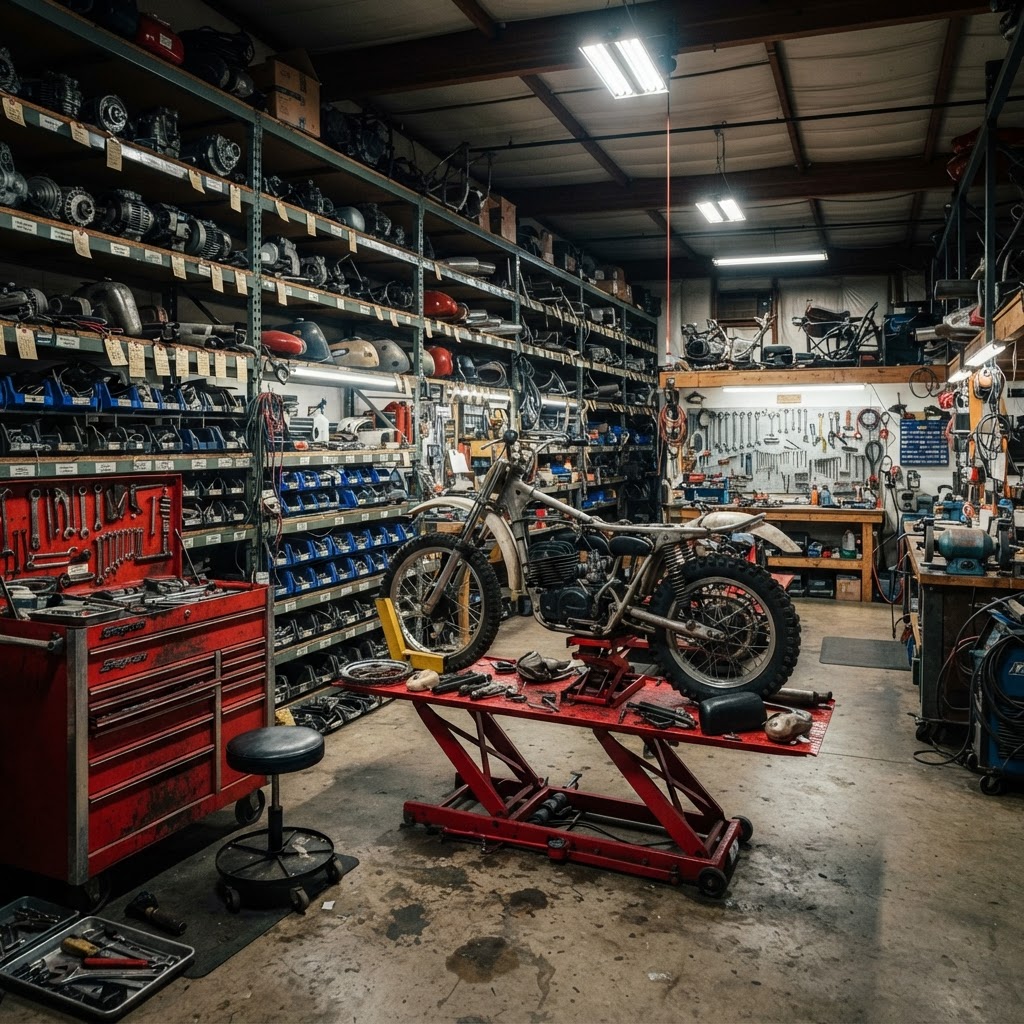
Have you ever looked at a wrecked, rusted, or non-running motorcycle and seen a hidden goldmine? While most people see a pile of junk taking up space in a barn, garage, or driveway, a growing community of dismantlers, mechanics, and savvy e-commerce sellers see pure, unadulterated profit. Welcome to the highly lucrative, fast-paced world of the salvage powersports business.
For decades, experienced enthusiasts have known a fundamental truth of the powersports industry: the sum of a motorcycle, ATV, or side-by-side's parts is almost always worth significantly more than the whole machine. But in recent years, this open secret has transformed from a greasy garage side hustle into a massive, scalable e-commerce industry. As new bike prices continue to soar and supply chains remain unpredictable, riders are constantly on the hunt for high-quality used OEM parts to keep their machines on the road, track, or trail.
Building a successful salvage operation is about much more than just tearing apart old bikes with an impact wrench. It requires strategic sourcing, meticulous inventory management, and an optimized sales channel strategy. In this comprehensive guide, we will break down the exact blueprint you need to turn junkyard finds into a highly profitable, full-time operation, detailing everything from acquiring your first donor bike to scaling your operations with specialized software.
The Economics of the Salvage Powersports Business
To understand why the salvage powersports business model works so incredibly well, you have to look at the math behind the used motorcycle market. When the average person decides to flip motorcycles, they typically hunt for a running or near-running bike, purchase it below market value, clean it up, fix a few minor mechanical issues, and attempt to sell it whole for a modest markup. While this can certainly generate a profit, it is fraught with financial risk. Hidden engine damage, title issues, and a fluctuating local market can easily wipe out your entire profit margin.
When you pivot to the salvage and dismantling model, the financial dynamics shift entirely in your favor. Instead of banking on a single high-ticket sale to a local buyer, you are breaking down the asset into dozens, if not hundreds, of individual SKUs that can be sold to a global audience. A crashed sportbike that holds a whole-bike market value of just $800 can easily contain $3,000 to $4,000 worth of viable OEM parts.
The profit margins in the salvage powersports business are often staggering compared to traditional retail. Because you are buying distressed assets—bikes that have been crashed, blown up, left out in the elements, or abandoned by frustrated owners—your initial acquisition cost is exceptionally low. Your primary investment becomes your time, your mechanical labor, and your ability to list those parts effectively online.
Furthermore, powersports vehicles are uniquely suited to the salvage model. Unlike automobiles, which require massive lots for storage and heavy machinery to move, motorcycles and ATVs are relatively compact. A single two-car garage can serve as a teardown facility, inventory warehouse, and shipping center for a budding dismantler. The parts themselves are also generally smaller, making them far easier and more cost-effective to ship across the country or around the world.
Sourcing Inventory: Finding the Right Junk Bikes
The lifeblood of any salvage operation is a steady, reliable stream of donor vehicles. You cannot generate consistent parts business income without a constant influx of inventory to dismantle. However, not all "junk" bikes are created equal. Learning how to source the right inventory is arguably the most critical skill you will develop.
Where to Find Donor Vehicles
There are several primary channels that successful dismantlers use to keep their bays full of profitable donor bikes:
- Salvage Auctions (Copart, IAAI): These platforms are the heavy hitters of the salvage world. Insurance companies dump thousands of crashed, flooded, and theft-recovered motorcycles here every week. While you may need a dealer or dismantler's license to bid in certain states, these auctions offer unparalleled volume.
- Local Classifieds (Facebook Marketplace, Craigslist): This is the bread and butter for many independent operators. You are looking for listings with keywords like "mechanic's special," "lost title," "non-running," or "needs work." Motivated sellers who just want a broken bike out of their sight are your best negotiating partners.
- Independent Mechanics and Dealerships: Building relationships with local repair shops can yield a massive return. When a customer brings in a bike with a blown engine and declines the expensive repair, the shop is often stuck with it. Offering to buy these abandoned projects for cash solves a problem for the mechanic and provides you with prime inventory.
Knowing What Sells
Before you hand over cash for a donor bike, you must know if the parts have aftermarket demand. A pristine 1995 touring cruiser might look like a great deal, but if there is zero market demand for its parts, it will just gather dust on your shelves. Conversely, certain categories are virtually guaranteed to sell. For example, Transmission components—such as gear clusters, shift forks, and primary drives—are in constant demand because they are highly stressed mechanical failure points. Similarly, Exhaust systems frequently suffer damage in crashes or rust out over time, making them high-turnover items.
The Teardown Process: A Step-by-Step Guide
Once you have secured a donor bike, the real work begins. An efficient, organized teardown process is what separates the hobbyists from the professionals. If you tear a bike apart carelessly, you risk damaging valuable components, losing critical hardware, and creating a "pile of doom" that makes listing impossible.
- Prep and Wash: Before touching a wrench, thoroughly wash the motorcycle. Removing years of grease, mud, and road grime makes the dismantling process significantly easier and ensures your parts look presentable when it is time to photograph them.
- Fluid Drain: Safely drain and dispose of all fluids, including engine oil, coolant, brake fluid, and gasoline. Environmental compliance is non-negotiable in a professional salvage powersports business.
- Systematic Dismantling: Work from the outside in. Remove the plastics, seat, and gas tank first. Then, move to the Exhaust system, lighting, and electrical components. Finally, pull the engine, drop the Transmission, and strip the frame.
- Inspection and Cleaning: As each part comes off the bike, inspect it for damage, cracks, or excessive wear. A quick wipe down with a parts cleaner will drastically improve the final presentation.
Managing this sheer volume of inventory is where many dismantlers hit a wall. When you are staring at 150 individual parts from a single motorcycle, relying on memory or a messy notebook is a recipe for disaster. This is why utilizing a specialized platform like RevParts is critical for tracking every bolt, bracket, and fairing right from the moment it comes off the bike.
Organizing, Tagging, and Inventory Management
If sourcing is the lifeblood of your business, organization is the skeleton that keeps it standing. The moment a part is removed and cleaned, it must be tagged and inventoried. The industry standard is the "tag and bag" method. Small parts and their associated mounting hardware are placed in heavy-duty clear zip-lock bags. A physical inventory tag is attached to the bag, detailing the donor bike's year, make, model, the specific part name, and a unique SKU number.
Larger items—like wheels, frames, and complete engines—are tagged directly and placed in designated bulk storage areas. Your warehouse or garage should be arranged logically with heavy-duty industrial shelving, with aisles labeled clearly (e.g., Aisle 1, Shelf B, Bin 4).
Once the parts are bagged and tagged, entering them into your RevParts dashboard immediately prevents them from becoming lost inventory. Proper software ensures that you always know exactly where a part is physically located in your shop, what condition it is in, and how much you have invested in it. This level of organization is absolutely mandatory if you want to generate a sustainable parts business income.
Deep Dive: The 1988 Kawasaki KDX200 Case Study
To truly grasp the profitability of this business, let's look at a highly specific, real-world example. Imagine you are browsing local classifieds on a Tuesday evening and you spot a 1988 Kawasaki KDX200. The seller is extremely frustrated; the engine has completely locked up, the plastics are faded from sitting in the sun, and they just want the machine out of their shed. They are asking $300.
If your goal was to flip motorcycles in running condition, this would be a terrible investment. The cost of sourcing vintage engine internals, paying for machine work, and replacing the plastics would easily eclipse the final resale value of the bike. You would lose time and money. But as a dismantler, you run the numbers through a completely different lens.
You know that vintage two-stroke enduro parts are highly sought after by restorers and vintage racers. You drive out with your trailer, negotiate slightly, and buy the bike for $250 cash.
Once back at the shop, you begin the teardown. You quickly discover that while the engine internals are indeed destroyed, other major components are remarkably well-preserved. You meticulously clean the exhaust system, take high-quality, well-lit photos, and list the 1988 Kawasaki KDX200 Spark Arrestor Muffler for $150.
Within a week, a vintage racer in another state buys it. Just like that, a single part has recouped 60% of your initial investment in the entire motorcycle. But you are just getting started. You pull the Transmission gear clusters and list them for $120. The front forks go for $150. The vintage carburetor, after a quick ultrasonic cleaning, sells for $80. The frame, which happens to have a clean, clear title, goes to a restorer for $200.
By the time you have finished selling the viable parts from this single "junk" bike, you have generated over $850 in revenue from a $250 investment. This $600 gross profit margin illustrates exactly why tearing down bikes is vastly superior to trying to flip them whole.
Listing Strategies to Maximize Parts Business Income
Having a warehouse full of meticulously tagged parts means nothing if nobody can find them online. Your ability to create highly optimized, searchable listings is the final barrier between your inventory and your bank account.
Photography is Everything
In the e-commerce parts game, your photos are your showroom. Buyers need to see exactly what they are purchasing, especially when dealing with used mechanical components. Invest in a clean, solid-colored backdrop (white or light grey works best) and bright, even LED lighting. Take photos from multiple angles, clearly highlighting any scratches, dents, or wear. Honesty in your photography prevents returns and angry customers down the line.
Titles, Descriptions, and Fitment Data
Your listing title needs to be packed with relevant keywords. Do not just write "Kawasaki Muffler." Write "1988 Kawasaki KDX200 Spark Arrestor Muffler OEM Exhaust 88 89 90." The more specific you are, the easier it is for a buyer's search query to land on your product.
Fitment data—knowing which other years and models a specific part will fit—is the ultimate cheat code in the salvage powersports business. That KDX200 muffler might also fit the 1989 and 1990 models. If you don't include that data, you are artificially shrinking your customer base.
When it is time to list that exhaust, using RevParts allows you to push the listing directly to your e-commerce channels with zero friction. RevParts acts as an end-to-end eBay Motors listing tool, syncing your available inventory with live marketplace data, automatically populating crucial fitment information, and ensuring your listings are highly visible to buyers actively searching for those exact components.
Fulfillment, Shipping, and Customer Service
Generating a sale is a fantastic feeling, but the transaction isn't complete until the part arrives safely in the buyer's hands. Shipping logistics can be intimidating for new dismantlers, but it becomes second nature with practice.
Small items like CDI boxes, relays, and hardware can be shipped cheaply and easily in padded envelopes. Medium items like an Exhaust system or a Transmission require sturdy corrugated boxes, heavy-duty packing tape, and ample bubble wrap to prevent shifting during transit. Large items, such as complete engines or frames, will require custom-built wooden crates and freight shipping accounts.
Customer service is equally important for maintaining your parts business income. Respond to buyer questions promptly. If a buyer asks for a specific measurement on a mounting bracket, go to the warehouse and measure it. Ship items within one business day whenever possible. Excellent customer service leads to high seller feedback scores, which in turn leads to better search rankings on platforms like eBay Motors.
Scaling Up: Building Your Salvage Empire
As you master the cycle of sourcing, tearing down, listing, and shipping, you will inevitably outgrow your initial workspace. What starts in a two-car garage will eventually need to transition into a commercial warehouse.
Scaling a salvage powersports business involves building out standard operating procedures (SOPs) and assembling a team. You will eventually hire dedicated teardown technicians whose only job is to break down bikes and clean parts. You will hire inventory specialists to photograph and list the items, and shipping clerks to pack boxes and print labels.
Managing a massive catalog of thousands of SKUs across multiple employees is virtually impossible with basic spreadsheets alone. Instead of manually copying and pasting data across different platforms, RevParts automates your workflow, acting as the central nervous system for your entire operation. As your business grows from a solo side hustle into a multi-bay commercial warehouse, RevParts scales with you, acting as the ultimate salvage parts marketplace and management tool.
Conclusion
The salvage powersports business model offers an incredible opportunity for anyone willing to put in the mechanical effort and operational discipline. By pivoting away from the risky gamble of trying to flip motorcycles whole, you can unlock the hidden value inside every wrecked, non-running, or abandoned machine. With strategic sourcing, a systematic teardown process, and a commitment to high-quality online listings, turning junk bikes into a highly profitable full-time income is not just possible—it is a proven, repeatable business model.
Ready to start listing your parts? Sign up free at RevParts → https://revpartspro.com/become-seller
Stay in the loop
Get the latest powersports tips, new parts alerts, and seller guides — straight to your inbox. No spam.