RevParts Syncs to Shopify & Facebook: Omnichannel Inventory
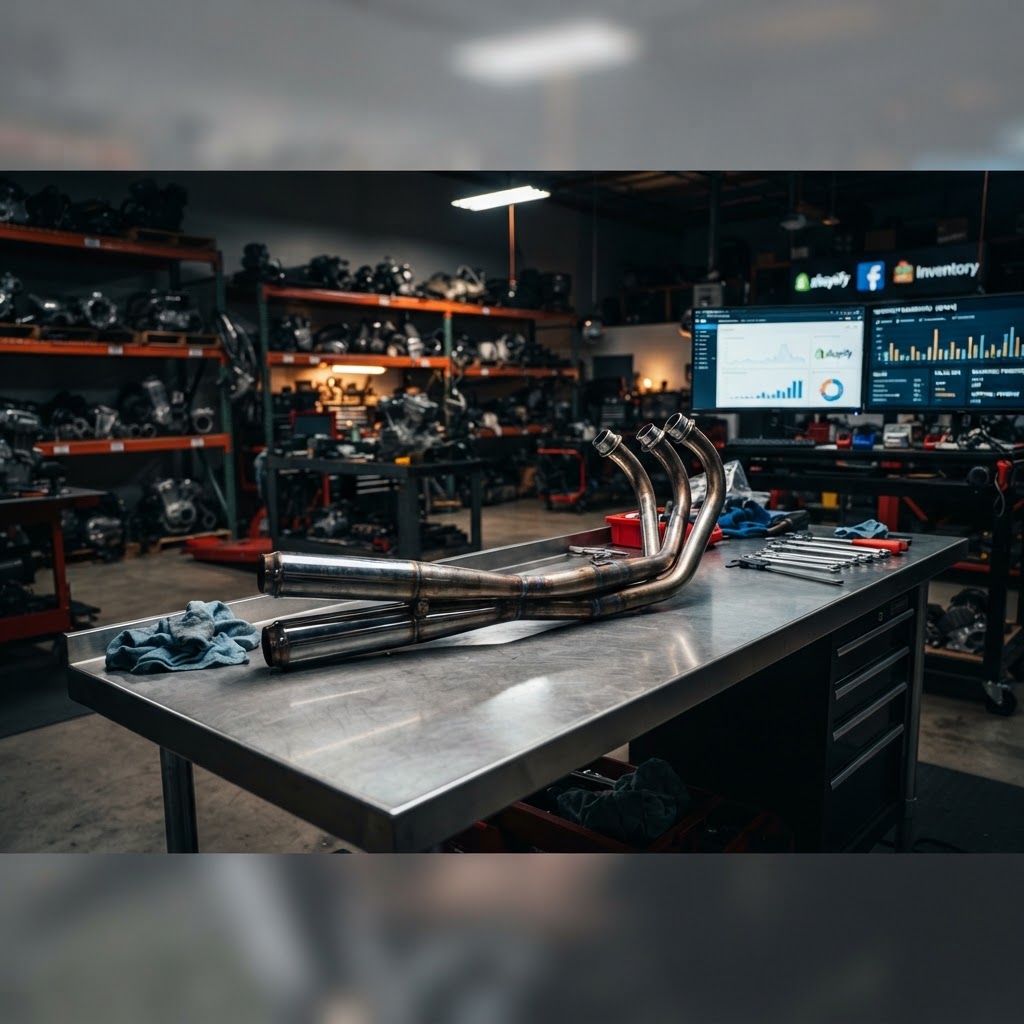
If you are running a powersports salvage yard or a motorcycle dismantling business, you already know that tearing down a wrecked dirt bike, ATV, or side-by-side is only half the battle. The real heavy lifting begins when you step away from the tools and sit down at the computer to inventory, price, and list those salvaged parts online. For years, eBay Motors has been the undisputed king of used powersports parts sales. It is where buyers go when they need a specific component, and it is where sellers have traditionally built their businesses. But the e-commerce landscape is shifting rapidly, and relying on a single marketplace is no longer enough to maximize your revenue.
Today's powersports enthusiasts and mechanics are shopping everywhere. They are buying parts directly from independent salvage websites, and they are impulsively purchasing components they stumble upon while scrolling through social media groups and marketplaces. To capture these modern buyers, you need your inventory to be visible everywhere at once. But how do you manage unique, one-off salvage listings across multiple platforms without losing your mind to manual data entry, or worse, double-selling a part you only have one of?
The answer lies in seamless, automated technology. We are thrilled to announce that RevParts has expanded its capabilities beyond eBay Motors. You can now push your listings directly to your independent e-commerce store and social media channels. By leveraging true omnichannel inventory sync, sellers can manage their parts from a single dashboard, dramatically increasing visibility while completely eliminating the risk of overselling. In this comprehensive guide, we will break down exactly how integrating Shopify and Facebook with your salvage operations can transform your business.
The Evolution of Powersports E-Commerce
To understand why expanding your sales channels is so critical, we have to look at how the powersports parts industry has evolved over the last decade. Ten years ago, if a rider laid down their Kawasaki and needed a replacement exhaust or a new fairing, they called local salvage yards or searched eBay. The buying journey was linear and predictable.
Today, the buying journey is fragmented. A rider might start their search on Google, which could lead them directly to an independent Shopify store. Or, they might be browsing a vintage motocross restoration group on Facebook, where a perfectly targeted ad or catalog post catches their eye. If your parts are only listed on eBay, you are entirely missing out on the Google search traffic and the social media scrollers.
The Danger of the Single-Channel Trap
Relying exclusively on one platform puts your business at significant risk. Marketplace algorithms change, selling fees fluctuate, and account suspensions—often triggered by automated bots—can instantly halt your cash flow. By diversifying where you sell, you protect your business. Building an independent website gives you an asset that you actually own, where you control the branding, the customer experience, and most importantly, the profit margins.
However, the barrier to multi-channel selling for dismantlers has always been inventory management. Unlike a retail store selling 500 identical t-shirts, a powersports salvage yard sells unique, single-quantity items with specific conditions, mileage, and fitment data. Listing a single used stator or exhaust header on three different websites manually takes three times as long. If it sells on one platform, you have to race to delete it from the others before someone else buys it. This operational bottleneck is exactly what our new update solves.
Unpacking the RevParts Shopify Integration
Shopify has emerged as the premier e-commerce platform for independent retailers, but out of the box, it is not optimized for the complex fitment data and unique SKUs required by auto and powersports salvage sellers. That is where a specialized RevParts Shopify integration becomes your most valuable asset.
How the Integration Works
When you use RevParts to catalog a dismantled vehicle, you input the part details, condition, fitment (Year/Make/Model), photographs, and pricing once. With the click of a button, that listing is pushed to your Shopify store perfectly formatted.
- Automated Title and Description Generation: The system uses your customized templates to create SEO-friendly titles and rich descriptions on your Shopify store, ensuring Google can index and rank your parts.
- High-Resolution Image Transfer: All the photos you take of the part on your workbench are instantly synced to the Shopify product page without needing to manually upload files twice.
- Custom Fitment Tags: Crucial fitment data is translated into Shopify tags and metafields, allowing your customers to filter parts on your website by their specific motorcycle or ATV model.
Why Shopify Powersports Stores Win
Operating a Shopify powersports store connected to your main inventory hub allows you to build a loyal customer base. When a buyer purchases from you on a third-party marketplace, they belong to the marketplace. When they buy from your Shopify store, you capture their email address, their phone number, and their purchase history. You can send them targeted email campaigns for seasonal maintenance, off-road gear, or parts from newly dismantled bikes. Furthermore, avoiding third-party marketplace fees on your independent site means you can either offer more competitive pricing to your buyers or simply enjoy higher profit margins on every single sale.
Tapping into Social Commerce with Facebook
While Shopify captures the buyers actively searching for parts, Facebook captures the buyers who do not even know they need a part yet. Social commerce is the fastest-growing segment in online retail, and the powersports community is incredibly active on Facebook. There are thousands of groups dedicated to specific motorcycle models, ATV restoration, and local off-road clubs.
The Power of Facebook Catalog Auto Parts
Manually posting individual parts to Facebook Marketplace or local groups is tedious and unscalable. With our new update, you can generate a dynamic Facebook catalog auto parts feed directly from your inventory software. This feed automatically syncs your available inventory to your Facebook Commerce Manager.
What does this mean for your business?
- Facebook Shops: You can host a fully functioning storefront on your Facebook Business Page. Customers can browse your entire salvage inventory without ever leaving the Facebook app.
- Dynamic Advertising: If a user visits your Shopify store and looks at a specific suspension shock but does not buy it, your Facebook catalog feed allows you to retarget them with an ad showing that exact part the next time they scroll their Facebook or Instagram feed.
- Automated Updates: Just like the Shopify integration, if the part sells elsewhere, your Facebook catalog is automatically updated to show the item as out of stock, preventing frustrated buyers and protecting your seller metrics.
The Mechanics of Omnichannel Inventory Sync
Throwing the term around is easy, but how does true omnichannel inventory sync actually function in the chaotic environment of a working salvage yard? It operates on a "Hub and Spoke" model.
RevParts acts as the central hub. This is where your warehouse team lives. They receive the wrecked vehicles, tear them down, barcode the parts, take photos, and input the data. The "spokes" are your sales channels: eBay Motors, your independent Shopify store, and your Facebook Shop.
Real-Time Quantity Management
Because you are dealing in one-off salvaged items, your quantity for a listing is almost always "1".
- Scenario: A buyer in California purchases your listed engine case on eBay at 2:00 PM.
- The Sync: Within moments, the central hub receives the sales notification from eBay. The software instantly sends API calls down the other spokes.
- The Result: By 2:01 PM, that engine case is marked as "Sold Out" on your Shopify store and removed from your active Facebook catalog.
This real-time communication eradicates the dreaded "double-sale" scenario, which traditionally forces sellers to cancel orders, issue refunds, deal with angry customers, and suffer algorithmic penalties on selling platforms.
Mini Case Study: Flipping a Vintage Exhaust
To see this technology in action, let's look at a real-world scenario from the Exhaust category.
Imagine you just acquired a classic dirt bike that has seen better days, but the exhaust system is in surprisingly good shape. You tear it down and pull a 1988 Kawasaki KDX200 Spark Arrestor Muffler. This is a highly sought-after vintage part for restoration enthusiasts. You clean it up, inspect it, and price it at $150.
The Old Way (Manual Multichannel)
You take photos on your phone. You sit at your desk and build the listing on eBay, manually entering the fitment data for the 1988 KDX200. That takes 10 minutes. Because it's a valuable vintage part, you also want it on your website. You open Shopify, upload the photos again, copy and paste the description, and publish it. That takes another 5 minutes. Finally, you go to a vintage Kawasaki Facebook group and create a manual post with the photos and a link. Total time: 20 minutes for one part.
Two days later, a restorer buys it on your Shopify site while you are asleep. You wake up, pack the box, and ship it. But you forget to take it down from eBay. That afternoon, someone buys it on eBay. Now you have to cancel the eBay order, take a defect on your seller dashboard, and write an apology message.
The RevParts Way (Omnichannel Inventory Sync)
You pull the 1988 Kawasaki KDX200 Spark Arrestor Muffler. Using the RevParts tool, you enter the condition and price ($150) and upload the photos once. You check the boxes for eBay, Shopify, and Facebook.
- Instant Distribution: The listing immediately goes live on eBay Motors with complete fitment data. It simultaneously appears on your Shopify store, beautifully formatted. It is instantly injected into your Facebook catalog.
- The Sale: A guy rebuilding his childhood KDX200 is scrolling through Facebook on his lunch break. He sees your dynamically generated catalog ad for the muffler. He clicks it, lands on your Shopify store, and buys it for $150.
- The Sync: The system registers the sale. Before the buyer even receives his confirmation email, RevParts has automatically ended the listing on eBay and removed it from Facebook.
You spent 3 minutes listing the part, achieved triple the visibility, avoided third-party fees by capturing the sale on your own site, and had zero risk of double-selling. That is the power of a modern salvage software stack.
Why Centralized Inventory is the Secret to Scaling
Many salvage yards hit a revenue ceiling not because they lack inventory, but because they lack the operational capacity to list and manage more parts. If your current team can manually list 50 parts a day across one channel, expanding to three channels manually would drop their output to 15 parts a day. You are working harder, not smarter.
By centralizing your operations with a tool designed specifically for the nuances of auto and motorcycle dismantling, you decouple your labor costs from your channel expansion. Listing a part on one platform takes the exact same amount of human effort as listing it on five platforms.
Furthermore, centralized inventory management simplifies your accounting and fulfillment. All orders, regardless of whether they originated from a social media click or an organic marketplace search, funnel into one unified dashboard. Your shipping team does not need to learn the back-end of Shopify, Facebook Commerce Manager, and eBay. They simply look at one screen, print the pick list, grab the parts from the warehouse bins, and print the shipping labels.
Future-Proofing Your Dismantling Business
The most successful sellers in the industry understand that they are no longer just in the "junk" business; they are in the e-commerce logistics business. As platforms continue to evolve, new marketplaces will emerge. The sellers who have their inventory meticulously organized in a central, cloud-based database will be able to plug into those new channels instantly. Those who rely on messy spreadsheets and manual processes will be left behind.
Getting Started with Multi-Channel Sync
Transitioning your business to a multi-channel model might seem daunting, especially if you have thousands of existing active listings, but the process is designed to be seamless.
Here is how you can begin transforming your salvage operation today:
- Consolidate Your Current Inventory: If your items are currently living exclusively on a marketplace, they can be imported into your central software hub, capturing all the existing photos, titles, and descriptions.
- Connect Your Shopify Store: The RevParts Shopify integration requires just a few clicks to authenticate. Once connected, you can map your categories (e.g., Engine, Exhaust, Suspension) so that parts automatically sort themselves perfectly on your website.
- Activate Your Facebook Catalog: Link your Facebook Business Manager. The system will generate a dynamic URL feed that Facebook will crawl daily to ensure your social storefront perfectly mirrors the physical parts sitting on your warehouse shelves.
- Establish a Standard Operating Procedure (SOP): Train your teardown and listing team on the new single-entry workflow. Emphasize taking high-quality photos, as these will now represent your independent brand on your own website, not just on a third-party marketplace.
- Launch and Monitor: Start pushing your new teardowns to all channels simultaneously. Watch as your independent store traffic grows and your reliance on single-marketplace sales decreases.
Selling salvaged powersports parts is a tough, gritty business, but your e-commerce strategy doesn't have to be. By embracing omnichannel inventory sync, you are taking control of your brand, expanding your reach, and ensuring that whether a rider is searching on Google, scrolling on Facebook, or browsing a marketplace, your parts are front and center.
Ready to start listing your parts? Sign up free at RevParts → https://revpartspro.com/become-seller
Stay in the loop
Get the latest powersports tips, new parts alerts, and seller guides — straight to your inbox. No spam.