Batch Photo Listing: AI Powersports Parts Identification
If you run a powersports salvage yard or a professional dismantling business, you know exactly where the real operational bottleneck lies. It is almost never in acquiring crashed motorcycles, damaged ATVs, or salvaged side-by-sides from auctions. It is not even in the physical teardown process, where experienced mechanics with greasy hands and pneumatic air tools can make incredibly quick work of a donor vehicle, reducing it to its base components in a matter of hours. The true bottleneck—the silent, insidious profit killer that plagues almost every salvage yard in the country—is the digital listing process. Sitting at a computer desk, uploading photographs one by one, manually typing out part numbers, researching years of fitment data, and trying to gauge market prices for hours on end rapidly drains your time, your energy, and your bottom line. It has long been considered the necessary evil of the online parts business, a tedious chore that must be endured to get your inventory in front of paying customers.
But what if that massive bottleneck could be completely shattered? The technology driving global ecommerce is advancing at a blistering pace, and the powersports salvage industry is finally getting its rightful share of this digital innovation. We are absolutely thrilled to introduce a groundbreaking feature designed specifically for dismantlers who need to move metal fast and efficiently: Batch Photo Listing. This is not just a minor software update; it is a fundamental reimagining of how salvage yards can process their inventory.
By combining the sheer processing power of rapid bulk inventory upload with cutting-edge AI part identification, this new tool is poised to completely revolutionize how you manage your warehouse operations from the ground up. Whether you are dealing with a massive, unorganized pallet of mixed exhaust components or the high-value remnants of a freshly torn-down vintage dirt bike, the ability to process and publish multiple listings simultaneously is no longer a futuristic dream. It is a tangible reality, and it is built right into the ecosystem you rely on to drive your daily sales. The era of manual, single-item data entry is coming to a close, and the era of intelligent, automated bulk processing has officially arrived.
The Evolving Landscape of Powersports Salvage
To fully appreciate the impact of this technological leap, we must first look at how the powersports salvage industry has evolved over the past two decades. Historically, a motorcycle salvage yard was a highly localized business. Customers would walk through the front door, ask the person at the counter for a specific carburetor or a set of front forks, and perhaps wander out into the yard to pull the part themselves. Inventory management consisted of a sharpie, some masking tape, and the encyclopedic memory of the yard owner.
However, the advent of online marketplaces irrevocably changed this dynamic. Suddenly, a seller in Ohio could sell a stator to a rider in California or even ship a cylinder head internationally. This expanded the customer base exponentially, but it also introduced a massive data problem. A single modern motorcycle can yield upwards of 200 to 300 highly saleable parts. When a salvage yard scales up its operations to process five, ten, or twenty vehicles a week, the sheer volume of individual items that need to be cataloged, photographed, priced, and listed becomes staggering.
In the traditional workflow, an employee must take photos of a part, transfer those photos from a camera or phone to a computer, crop and edit the images, log into their inventory system, manually type in a title, cross-reference the OEM part number, write a detailed description noting any scratches or dents, assign a warehouse bin location, and then finally push that listing live. Even for a highly efficient worker, a single listing can take anywhere from five to twelve minutes. When you multiply that by hundreds of parts, the labor costs skyrocket, and the delay between tearing down a bike and actually making those parts available for sale can stretch into weeks. This lag time ties up capital and slows down the growth of the business.
Overcoming the Manual Listing Bottleneck
This is precisely where the concept of batch listing powersports parts changes the entire equation. Instead of treating every single component as a separate, isolated data entry task, batch processing allows sellers to group their inventory tasks together, drastically reducing the friction between the teardown table and the digital storefront.
Imagine removing the need to switch contexts constantly. Context switching—moving from taking a photo, to typing on a keyboard, to researching on a separate tab, and back to taking a photo—is a known productivity killer. With a batch-oriented workflow, you can compartmentalize your tasks. You can spend an hour doing nothing but taking high-quality photographs of fifty different parts. Then, you can upload all of those images in one single action.
The challenge, historically, with bulk uploading has always been data association. If you upload 300 photos representing 50 different parts, how does the software know which photos belong to which part, and more importantly, what those parts actually are? This is the exact hurdle that has kept many salvage operations tethered to the slow, one-by-one listing method. They simply could not trust automated systems to accurately sort and identify complex, greasy, used motorcycle components. But that was before the integration of advanced artificial intelligence and machine learning algorithms specifically trained on powersports data.
Introducing the RevParts Batch Lister
At RevParts, we understand that your primary goal is to sell parts quickly, accurately, and profitably. We know that every minute you spend wrestling with a listing interface is a minute you aren't spending sourcing new inventory or fulfilling orders. That is why we developed the RevParts batch lister, a comprehensive solution engineered from the ground up to eliminate the friction in your listing workflow.
This new tool seamlessly integrates into your existing seller dashboard, providing a robust, highly intuitive interface for handling massive amounts of inventory data simultaneously. The RevParts batch lister isn't just a simple file uploader; it is an intelligent digital assistant that actively works alongside you to categorize, price, and publish your items.
By utilizing our proprietary bulk inventory upload system, you can drag and drop hundreds of high-resolution images directly into the platform in seconds. The system automatically groups photos based on timestamp and visual similarity, creating distinct digital "buckets" for each individual part. But the true magic happens in the next step, where our specialized technology takes over the heavy lifting of identification and data population.
Deep Dive: How AI Part Identification Works
So, how exactly does a computer look at a dirty, heavily used piece of metal and know what it is? The answer lies in the incredible power of AI part identification.
Our artificial intelligence models have been meticulously trained on millions of data points, encompassing a vast array of motorcycles, ATVs, UTVs, dirt bikes, and personal watercraft. We feed the neural network countless images of stators, rotors, exhaust headers, throttle bodies, brake calipers, and suspension linkages. Over time, the AI learns to recognize the distinct geometric shapes, the placement of mounting tabs, the routing of cables, and the unique visual signatures of different OEM components.
When you utilize the bulk inventory upload feature, the AI immediately goes to work on your images. First, it performs object detection, separating the part from the background of your staging table. Next, it analyzes the visual characteristics of the item. For example, if it sees a cylindrical object with a specific mounting bracket and an integrated heat shield, it cross-references this visual data against its massive library of powersports components.
Furthermore, the AI is capable of Optical Character Recognition (OCR). This means it can actually read the stamped OEM part numbers, casting marks, and manufacturer logos directly from your photographs. By combining the visual shape recognition with the extracted text data, the AI part identification system can accurately pinpoint the exact year, make, and model the part came from. It automatically generates a highly optimized SEO title, pulls in the correct fitment compatibility chart, and even suggests a competitive market price based on current historical sales data. What used to require ten minutes of manual internet research is now accomplished in milliseconds by the algorithm.
Step-by-Step: From Teardown to Bulk Inventory Upload
Transitioning to this modern workflow is surprisingly simple. Here is a step-by-step guide to maximizing your efficiency using the RevParts batch lister:
1. Optimize Your Photography Station
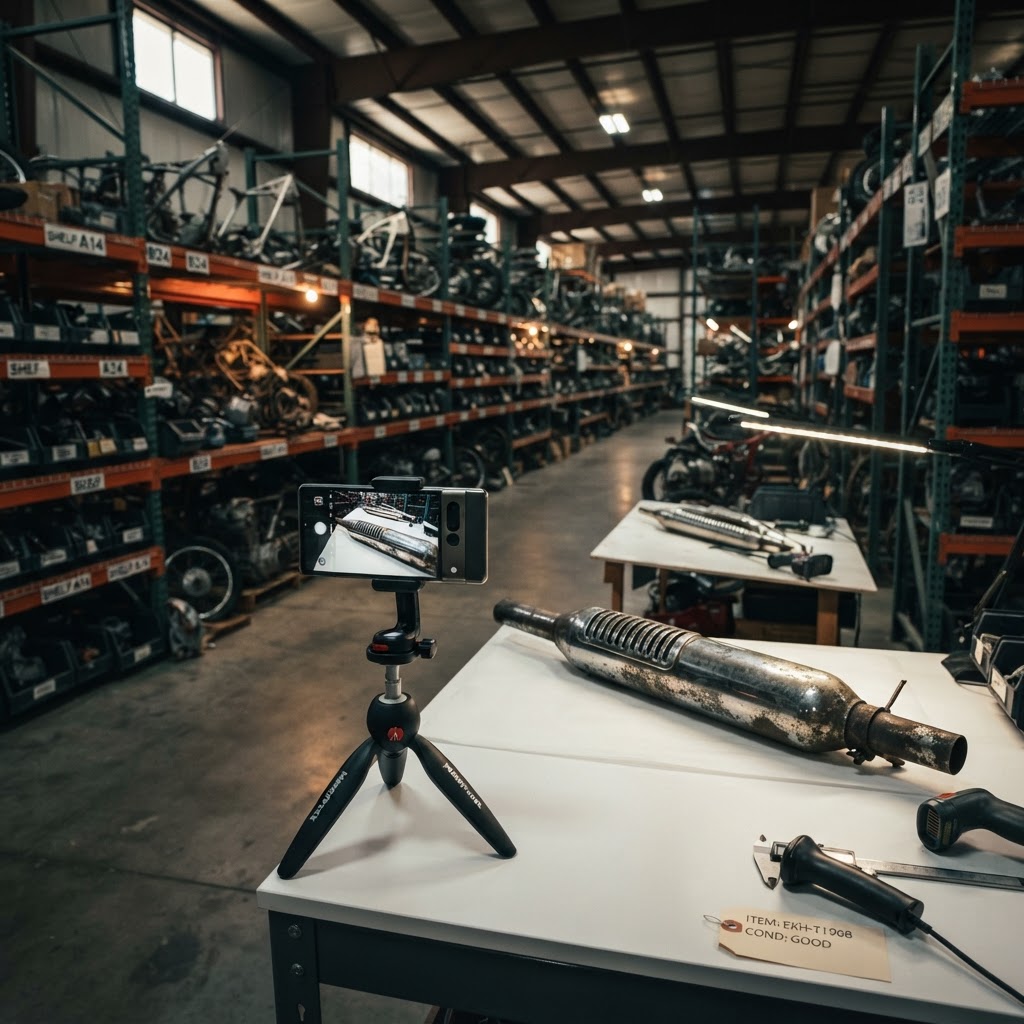
Set up a dedicated photography area with bright, even LED lighting and a clean, contrasting background (a white or light gray table works best). Good lighting is crucial, as it helps the AI accurately detect the edges and read any stamped numbers on the part.
2. The Rapid Capture Process
Bring a cart full of cleaned parts to your station. Using your smartphone or a digital camera, take 3 to 5 photos of the first part, making sure to capture all angles, any damage, and close-ups of part numbers. As soon as you finish the first part, immediately move it aside and place the next part on the table. Do not stop to type anything. Just keep shooting until the entire cart is empty.
3. Initiate the Bulk Inventory Upload
Transfer your photos to your computer (or use our mobile-friendly web interface) and drag the entire batch of images into the RevParts batch lister. The software will instantly begin uploading the high-resolution files securely to the cloud.
4. Let the AI Go to Work
Once uploaded, click the "Analyze Batch" button. The AI part identification engine will sweep through your images, grouping the photos into individual listings, identifying the components, extracting part numbers, and pre-filling the listing details, including titles, categories, and suggested pricing.
5. Review, Adjust, and Publish
You will be presented with a clean spreadsheet-style grid containing all of your newly generated listings. You simply scroll through, verify the AI's suggestions, add any specific notes about the condition (e.g., "minor rust on flange"), assign your warehouse bin numbers, and click "Publish All." In one click, dozens of parts are pushed live to your storefront and synchronized across your sales channels.
Mini Case Study: Unlocking Value in a 1988 Kawasaki KDX200
To truly illustrate the transformative power of batch listing powersports parts, let us look at a real-world scenario that salvage yards encounter every day. Imagine you just acquired a vintage 1988 Kawasaki KDX200. This is a legendary 2-stroke enduro bike, and its parts are highly sought after by vintage motocross restorers. However, older bikes are notoriously difficult to list because OEM part numbers are often worn off, and cross-compatibility data is scarce.
Your mechanic strips the bike down. You take the entire exhaust system, including the expansion chamber and the muffler, to your photo station. Specifically, you have the 1988 Kawasaki KDX200 Spark Arrestor Muffler in your hands. In a traditional workflow, identifying this exact silencer, confirming it fits the 1988 model year (and checking if it crosses over to the 1989 or the KX125), and finding the current market value would be a tedious research project.
You snap four quick photos of the muffler, ensuring you capture the specific forestry service stamp and the mounting brackets. You do the same for the carburetor, the front forks, the seat, and the fuel tank.
You upload the entire batch into RevParts. The AI part identification system instantly recognizes the unique, elongated shape and specific mounting points of the KDX200 exhaust. It reads the faded "KHI" stamping. Without you typing a single word, the system generates the title: "1988 Kawasaki KDX200 OEM Spark Arrestor Muffler Exhaust Silencer." It automatically places it into the Active RevParts categories: Exhaust.
Crucially, the AI looks at historical sales data for vintage Kawasaki parts and recognizes that this specific spark arrestor, intact and without major dents, is a rare commodity. It suggests an optimal listing price of $150. You review the listing grid, assign it to Bin C-4, and approve it alongside the other 40 parts from that teardown. What would have normally taken three to four hours of grueling manual entry is completely finished in under twenty minutes.
Synergizing with eBay Motors Bulk Listing
While having your parts listed on a dedicated platform is fantastic, any seasoned powersports dismantler knows that multichannel selling is the absolute key to high inventory turnover. You have to be where the buyers are, and millions of mechanics and riders start their search for used parts on eBay.
However, navigating eBay's native listing tools when dealing with hundreds of salvage items can be incredibly frustrating. Their standard interface is designed for the casual seller listing a handful of items, not a high-volume warehouse pushing thousands of SKUs a month.
This is where our system provides an unparalleled advantage. The platform is deeply integrated with eBay's API, meaning that once you have reviewed and approved your batch within our dashboard, you can trigger an eBay Motors bulk listing action with a single click. The software seamlessly translates all of the AI-generated data—the optimized titles, the rich item specifics, the detailed fitments, and the high-resolution images—and pushes them directly to your eBay store.
It automatically formats the listings to comply with eBay's strict seller requirements, ensuring your parts rank high in their search algorithm. By combining our internal bulk tools with the massive reach of an eBay Motors bulk listing strategy, you are effectively putting your sales on autopilot, ensuring maximum visibility across the internet's largest automotive and powersports marketplaces.
Maximizing ROI: Best Practices for Photography and Processing
While AI is incredibly powerful, it still relies on the quality of the data it is fed. To get the absolute best results from the AI part identification system and ensure your batch listings are as accurate as possible, we recommend implementing a few simple best practices in your warehouse:
- Prioritize Cleanliness: You do not need to polish parts to a mirror shine, but wiping away thick layers of grease or caked-on mud makes a massive difference. If the AI can clearly see the contours of the metal and the stamped part numbers, its accuracy skyrockets.
- Consistent Backgrounds: Always shoot your parts on a solid, contrasting background. A cluttered workbench with tools and other parts in the background can confuse the object detection algorithms. A simple white vinyl tabletop is inexpensive and highly effective.
- Capture the Details: Make sure your first photo is a clear, well-lit shot of the entire part. Then, take close-ups of any identifying marks, casting numbers, electrical connectors, or damage. The more visual information you provide, the better the AI can cross-reference its database.
- Maintain Batch Integrity: Try to process parts from the same vehicle in a single batch. If the system knows that the batch is primarily from a 1988 Kawasaki KDX200, it can use that context to make even more accurate predictions about the smaller, more obscure components in that specific upload.
The Future of Powersports Dismantling is Here
The powersports salvage industry is highly competitive, and the yards that survive and thrive are the ones that adapt to new technologies. The days of accepting the listing bottleneck as a normal part of doing business are over. By embracing batch listing powersports parts, you are not just saving a few minutes here and there; you are fundamentally transforming your labor costs, dramatically increasing your inventory turnover rate, and freeing up your valuable time to focus on growing your business.
The integration of AI part identification and seamless bulk inventory upload represents a paradigm shift in warehouse management. From quickly identifying a vintage $150 spark arrestor to executing a massive eBay Motors bulk listing push, the tools you need to dominate your market are finally at your fingertips.
Stop wasting hours on manual data entry and start moving your inventory faster than ever before. Ready to start listing your parts? Sign up free at RevParts → https://revpartspro.com/become-seller
Stay in the loop
Get the latest powersports tips, new parts alerts, and seller guides — straight to your inbox. No spam.