Batch Listing Powersports Parts with AI Photo ID
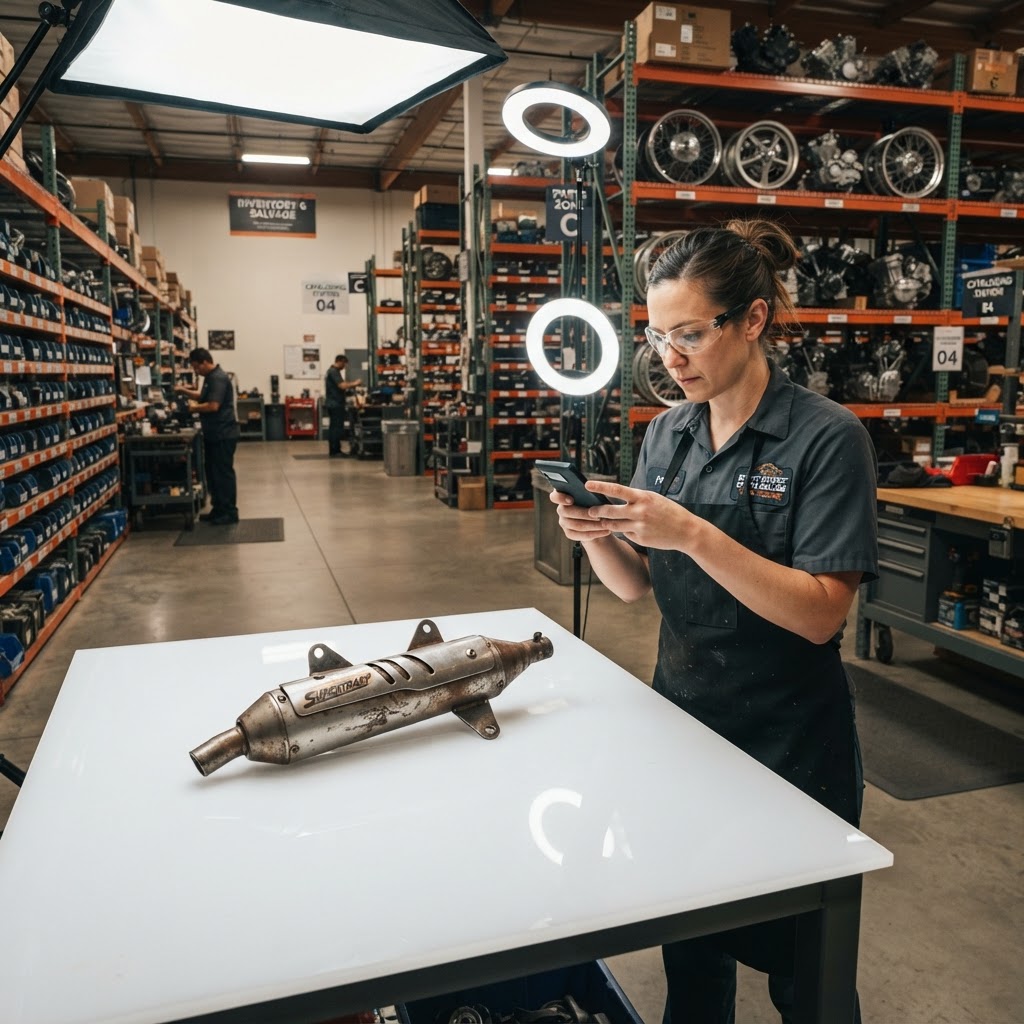
Picture this familiar scenario: your teardown bay is absolutely full. You have just acquired a fresh lot of late-model sportbikes, ATVs, and a few highly sought-after vintage dirt bikes from an auction. Your dismantler is completely in the zone, air ratchets spinning, pulling pristine parts off frames in record time. The physical dismantling process in your shop is a masterclass in mechanical efficiency. But then comes the inevitable bottleneck: the dreaded transition from the grease of the shop floor to the digital storefront.
Historically, powersports salvage has been a tale of two vastly different speeds. You can completely tear down a motorcycle in just a few hours, but listing those individual parts online takes days. Every single part requires you to stop what you are doing, take multiple photos, meticulously type out a title, look up exact fitment data, check competitor pricing, and manually build a listing from scratch. When you multiply this tedious process by the hundreds of individual parts that come off a single bike, your profit margins start getting eaten alive by administrative labor hours.
Time is money in the powersports salvage business. Every single hour a part sits unlisted on a warehouse shelf is an hour it isn’t making you money. You need a digital system that actually matches the rapid speed of your physical teardown. That is exactly where our revolutionary new software feature comes into play. We are thrilled to introduce our newest capability: batch listing powersports parts equipped with cutting-edge AI photo identification. This is a game-changing workflow designed specifically for powersports dismantlers who want to aggressively scale their operations, dramatically speed up their bulk inventory upload processes, and dominate the online marketplace without hiring an army of data entry clerks.
The Hidden Cost of Manual Entry in Powersports Salvage
Manual data entry is the absolute enemy of operational scale. To truly appreciate the power of automation, we first have to look at the traditional workflow for processing a single salvaged part and the hidden costs associated with it.
Let us break down the standard operating procedure for most salvage yards:
- Cleaning and Prep: You wash and degrease the part.
- Photography: You set up your lighting, position the part, and take 3 to 6 photos from different angles.
- File Transfer: You manually transfer those photos from your phone or digital camera to a desktop computer via SD card, cloud link, or email.
- Data Entry: You manually type out the year, make, model, sub-model, and specific part name.
- Research: You scour the internet to find the OEM part number and the exact fitment range (which years and models share this same part).
- Market Analysis: You check competitor pricing on various marketplaces to ensure you are competitive.
- Listing Creation: You finally create the listing, fill out item specifics, and publish it.
This labor-intensive process takes an average experienced lister anywhere from 5 to 10 minutes per part. For a complete motorcycle teardown yielding 100 sellable parts, you are looking at 8 to 16 hours of purely administrative work. If you are paying an employee $20 an hour to do this, each part costs you around $2 to $3 just to list. This simply does not scale if you want to grow your salvage yard. By transitioning to batch listing powersports parts, you effectively eliminate these repetitive bottlenecks, allowing your team to focus on processing more vehicles rather than staring at a computer screen.
What is AI Part Identification?
What if your camera was also your most experienced cataloging expert? What if the simple act of taking a photograph automatically initiated the entire listing process? That is the incredible power of AI part identification.
Moving Beyond Basic Image Recognition
When we developed this feature, we didn't just plug into a generic image recognition tool. Standard image recognition might look at a photo and tell you it sees a "metal pipe" or a "motorcycle." That is entirely useless for a professional dismantler. Instead, we trained our proprietary artificial intelligence models on millions of specific powersports parts, ranging from modern sportbike fairings and ATV differentials to vintage exhaust systems and obscure engine internals.
Training the Machine Learning Models
The AI looks at the specific geometry, material composition, wear patterns, and visual context of the part in the photograph. It acts like a seasoned mechanic who has been in the industry for forty years. When you point the camera at a component, the AI cross-references the visual data against a massive database of OEM specifications. It doesn't just guess; it analyzes. It automatically suggests the correct part name, assigns the optimal category, and even pulls up the relevant fitment data, saving you from doing the heavy lifting.
The Power of Batch Listing Powersports Parts
Transitioning from single-item manual entry to batch listing powersports parts represents a fundamental shift in how your business operates. It moves you from an archaic "one-by-one" assembly line to a modern, parallel processing environment.
Unlocking True Operational Scale
When you utilize a bulk inventory upload system, you are no longer constrained by the typing speed of your staff. You can have one person rapidly taking photos of 50 different parts in a row. They do not stop to type; they simply photograph, move the part aside, and photograph the next one. The batch upload system takes that entire folder of images and processes them simultaneously in the background.
Reducing the Need for Expert Listers
In the past, the person creating your listings needed deep, encyclopedic knowledge of motorcycles and ATVs. They needed to know the difference between a stator and a rotor, or a monoshock and a twin shock setup. Finding employees with this specific mechanical knowledge who also want to do data entry is incredibly difficult and expensive. With AI part identification, the software holds the mechanical knowledge. You can hire an entry-level employee whose only job is to take clear, well-lit photos. The AI acts as the expert, categorizing and titling the parts accurately, which radically lowers your payroll costs and training time.
Step-by-Step: Mastering the RevParts Batch Lister
To truly understand the impact of this technology, let us walk through the exact workflow using the RevParts batch lister. We have designed this interface to be as intuitive and frictionless as possible for busy shop environments.
Step 1: Preparation and Teardown
Your mechanic completes the teardown of a vehicle. All sellable parts are cleaned, inspected for damage, and placed on a large staging cart. There is no need to write physical tags for each part unless that is part of your internal bin-location strategy.
Step 2: The Bulk Inventory Upload
Using a smartphone, tablet, or digital camera, your photography specialist takes photos of each part on the cart in rapid succession. Once the cart is finished, they initiate a bulk inventory upload directly into the RevParts platform. You can upload hundreds of images at once simply by dragging and dropping the files or syncing directly from your mobile device.
Step 3: AI Processing and Data Enrichment
This is where the magic happens. As the images hit the RevParts servers, the AI part identification engine immediately goes to work. It automatically groups photos that belong to the same part based on timestamp and visual similarities. It then analyzes the primary photo of each group, identifies the part, suggests an SEO-optimized title, assigns it to the correct internal category, and links it to the donor vehicle's year, make, and model information that you previously entered.
Step 4: Quality Assurance and Pricing
Instead of building listings from scratch, your job is now simply to review the AI's work. You are presented with a streamlined grid view of all your newly processed parts. You quickly scan the suggested titles and categories. If everything looks correct, you simply input your selling price and assign a warehouse bin location. What used to take hours of typing now takes minutes of clicking "Approve."
Step 5: Multi-Channel Publishing
Once approved, the RevParts batch lister instantly pushes your new inventory across all your connected sales channels, including your own hosted website and third-party marketplaces. The speed from teardown to live online listing is reduced from days to a matter of hours, maximizing your inventory turnover rate.
Real-World Case Study: Tearing Down a 1988 Kawasaki KDX200
To illustrate exactly how this workflow dominates traditional methods, let's look at a specific, real-world example from the powersports salvage industry.
Imagine you just purchased a classic 1988 Kawasaki KDX200 from a local barn find. It is a fantastic vintage enduro dirt bike, and functional OEM parts for this era are highly sought after by restorers and vintage racing enthusiasts.
The Challenge of Vintage Exhaust Categories
One of the most valuable and difficult-to-list parts on this specific bike is the exhaust system, specifically the Spark Arrestor Muffler. The Exhaust category is notoriously tricky. Vintage mufflers often have surface rust, missing heat shields, or minor dents that make them hard for an untrained eye to identify correctly. Furthermore, determining exactly which years of the KDX200 share this exact spark arrestor design requires tedious cross-referencing of vintage microfiches.
The AI Solution in Action
In the old days, you would pull this muffler, clean it up, and spend 15 to 20 minutes researching the exact fitment, searching forums, and looking at old parts diagrams. You might accidentally list it with the wrong year range, resulting in an angry customer return, or you might leave out crucial keywords in the title.
With our new workflow, your employee simply snaps a few photos of the muffler right on the shop table. They upload them via the RevParts batch lister. Within seconds, the AI part identification recognizes the distinct shape and mounting points of the two-stroke silencer. It accurately identifies it as an exhaust component and suggests the perfect, high-converting title: 1988 Kawasaki KDX200 Spark Arrestor Muffler.
Because the software is tied into historical market data, you know the market demand is high. You confidently price it at $150. What used to take 15 minutes of frustrating research now takes 30 seconds of review. When you multiply that time savings by the stator, the Mikuni carburetor, the front forks, the swingarm, and the CDI box, you have just listed the entire KDX200 inventory in a tiny fraction of the time it used to take.
Maximizing Reach with eBay Motors Bulk Listing
Having your parts cataloged internally is great, but integration is the key to actual revenue. You don't just want parts sitting in a private database; you want them pushed out in front of millions of active buyers. This is why eBay Motors bulk listing integration is a foundational pillar of our platform.
The Importance of Fitment Data
Selling on eBay Motors successfully requires mastering their fitment compatibility system. Buyers rarely search by part number; they search by their vehicle (e.g., "1988 Kawasaki KDX200 exhaust"). If your listing does not have the correct structured fitment data attached to it, it simply will not show up in the buyer's search results, no matter how perfectly you priced it.
Syncing Inventory Seamlessly
Once the AI has done the heavy lifting and identified the parts, RevParts seamlessly pushes your entire batch straight to your eBay account. We automatically handle the complex mapping of item specifics, the category routing, and most importantly, the fitment compatibility matrix. Our eBay Motors bulk listing feature ensures that your spark arrestor muffler shows up exactly when a buyer filters by their specific Kawasaki model, significantly increasing your sell-through rate and reducing your time-to-sale.
Best Practices for Photographing Powersports Parts for AI
While our AI part identification is incredibly advanced, it still relies on the quality of the visual data you feed it. To get the highest accuracy rates and the fastest workflow possible, it is essential to train your teardown team on basic photography best practices.
- Use Consistent Backgrounds: Always shoot your parts on a clean, solid-colored background. A white or light gray photography table works best. Avoid photographing parts on the messy shop floor or on top of greasy rags, as cluttered backgrounds confuse the AI and look unprofessional to buyers.
- Prioritize Good Lighting: Shadows are the enemy of image recognition. Invest in inexpensive LED studio lights or overhead shop lights to ensure the part is evenly illuminated. The AI needs to see the texture of the metal, the color of the plastic, and any identifying marks clearly.
- Capture Angles and Part Numbers: Your first photo (the primary photo) should be a wide, clear shot of the entire part. Subsequent photos should show different angles, mounting points, and importantly, zoom in on any stamped OEM part numbers or casting marks. The AI can read these numbers via optical character recognition (OCR) to further guarantee accuracy.
- Show Damage Clearly: While the AI identifies the part, you still need to be honest with your buyers. Clearly photograph any scratches, dents, or rust. Transparency reduces return rates and builds your reputation as a trusted dismantler.
- Keep Sets Together: If you are selling a set of four turn signals or a complete brake caliper assembly, photograph them together in the first shot so the AI understands it is a bundled listing.
Training Your Team for the New Workflow
Implementing new technology in a salvage yard can sometimes meet resistance from veteran employees who are used to doing things "the old way." The key to a successful rollout of the RevParts batch lister is proper communication and training.
Show your team how the bulk inventory upload feature is not there to replace them, but to make their jobs significantly easier and less frustrating. Nobody enjoys sitting at a desk typing out variations of "motorcycle left side fairing bracket" fifty times a day. By removing the tedious data entry, your staff can focus on the more engaging, hands-on aspects of the powersports industry. Within a week of using the new system, most teams report that they could never imagine going back to the old, manual way of listing parts.
The ROI of AI-Powered Batch Listing
Let us conclude by looking at the hard numbers. Implementing AI part identification isn't just a neat technological trick; it is a serious financial decision with an immediate Return on Investment (ROI).
If your yard processes 5 motorcycles a week, and each yields 60 parts, that is 300 parts a week. At 8 minutes per part manually, that is 40 hours of labor—a full-time employee dedicated solely to listing.
By utilizing batch listing powersports parts, you can reduce that time to roughly 1 minute per part (including photography and review). Those 300 parts now take only 5 hours a week. You have just freed up 35 hours of labor. That employee can now be redeployed to pulling more parts, fulfilling orders faster, or processing entirely new vehicles. Your inventory turnover skyrockets, your warehouse space is optimized because parts don't sit unlisted, and your revenue scales without adding a single dollar to your payroll overhead.
Frequently Asked Questions (FAQ)
Does the AI recognize aftermarket parts? Yes. While OEM parts are the easiest to identify, our AI is constantly learning and can identify common aftermarket brands, performance exhausts, and custom fairings based on visual cues and logos.
What if the AI makes a mistake? The AI provides suggestions, but you always have the final say. During the review step in the RevParts batch lister, you can easily overwrite any title, price, or category before it gets published. The system learns from your corrections, making it even smarter for your specific inventory over time.
Can I use my existing smartphone to take photos? Absolutely. You do not need expensive DSLR cameras. Modern smartphone cameras are more than capable of capturing the high-resolution images required for both AI part identification and professional eBay listings.
How does this integrate with my existing inventory? The bulk inventory upload perfectly complements your existing catalog. New batch uploads simply add to your current available stock without disrupting your established SKUs or bin locations.
Take Your Salvage Yard to the Next Level
The powersports salvage industry is becoming more competitive every single day. The yards that thrive in the future will be the ones that leverage technology to process inventory faster, cheaper, and more accurately than their competitors. You have the mechanical skills, you have the donor vehicles, and now, you finally have the software to match your ambition.
Stop wasting thousands of dollars on manual data entry. Stop letting valuable inventory sit unlisted on your shelves because your team doesn't have the time to catalog it. Embrace the future of powersports dismantling with our advanced AI tools and seamless marketplace integrations.
Ready to start listing your parts? Sign up free at RevParts → https://revpartspro.com/become-seller
Stay in the loop
Get the latest powersports tips, new parts alerts, and seller guides — straight to your inbox. No spam.