Motorcycle Parts Inventory Management: A Dismantler's Guide
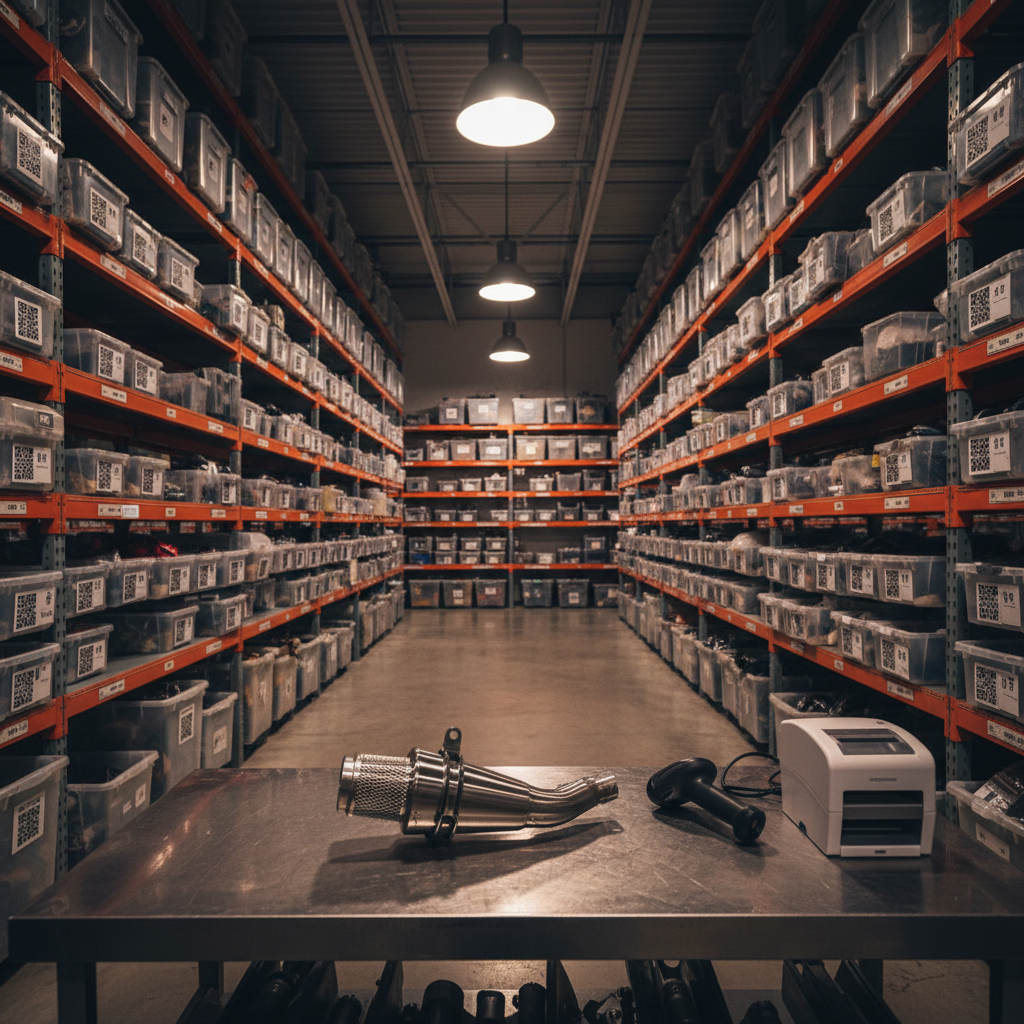
If you have ever walked into a growing powersports salvage yard, you know the exact atmosphere: a mix of old gasoline, industrial degreaser, and pure opportunity. A single wrecked motorcycle, ATV, or side-by-side represents a goldmine of individual components waiting to be harvested, cleaned, and sold to riders desperate to get back on the trail or track. But there is a very fine line between a profitable, well-oiled dismantling operation and a chaotic warehouse full of unidentified metal.
For professional dismantlers, the true challenge does not lie in turning a wrench—it lies in organization. When a single donor vehicle can yield upwards of 100 to 150 individual sellable components, a shop processing just ten bikes a week is suddenly staring down thousands of new SKUs every single month. Without a rigid, highly structured system for tracking where each part came from, its current condition, and exactly which bin it lives in, your salvage yard will quickly become a nightmare of lost profits and wasted time.
The most painful scenario for any eBay Motors or salvage marketplace seller is hearing the ping of a lucrative online sale, walking back to the warehouse, and spending forty-five minutes frantically searching for a part that seems to have vanished into thin air. You are forced to cancel the order, your seller rating takes a massive hit, and you lose money. To prevent this, scaling your business requires adopting professional-grade motorcycle parts inventory systems. In this comprehensive guide, we will break down exactly how elite dismantlers organize, tag, and track their massive catalogs, and how leveraging the right parts management software can transform your salvage yard from a chaotic garage into a high-profit e-commerce powerhouse.
The Dismantler's Dilemma: Why Motorcycle Parts Inventory is Unique
Managing a massive warehouse of new retail products is relatively straightforward. You have one hundred identical helmets, all in the same box, all with the exact same UPC barcode. Motorcycle salvage is an entirely different beast. Every single part you pull off a donor bike is effectively a unique snowflake, bringing its own set of logistical challenges that standard retail software simply cannot handle.
First, you are dealing with extreme condition variations. You might have ten left fairings for a 2015 Yamaha R6 in your warehouse right now, but one has a deep scratch from a low-side crash, one has a broken mounting tab, and one is in absolute mint condition. If your inventory system cannot seamlessly differentiate between these specific items, you risk shipping a heavily damaged part to a customer who paid top dollar for a pristine one.
Second, fitment data—also known as year, make, and model compatibility—is notoriously complex in the powersports industry. A single stator, fuel pump, or clutch master cylinder might fit thirty different models across a ten-year production run spanning multiple sub-models. If your inventory data does not accurately reflect this vast cross-compatibility, you are leaving massive amounts of money on the table by hiding your parts from potential buyers who are searching for their specific bike model.
Finally, the physical storage requirements are incredibly irregular. A complete motorcycle frame takes up a massive amount of physical space and requires heavy-duty racking, while a tiny throttle position sensor can get lost in the palm of your hand. Efficient motorcycle parts inventory management requires a storage methodology that can accommodate massive disparities in size, weight, and fragility, all while ensuring that the picking and packing process remains lightning fast for your fulfillment team.
The Core Components of an Iron-Clad Inventory System
Before you can even think about software integrations or selling online, you must establish the physical architecture of your warehouse. Professional dismantlers do not just throw parts on a shelf where they happen to fit; they build a highly structured micro-economy of bins, aisles, and specialized zones.
1. Macro to Micro Binning and Location Tracking
The absolute foundation of any large-scale salvage operation is a logical, alphanumeric binning system. Every single inch of your shelving must be mapped, categorized, and clearly labeled. A standard warehouse layout typically follows this hierarchy:
- Zone: The general area of the warehouse (e.g., Zone A for Engines, Zone B for Plastics, Zone C for Electrical).
- Aisle: The specific row of heavy-duty shelving (e.g., Aisle 12).
- Section/Bay: The vertical column of shelves within that aisle (e.g., Bay C).
- Shelf: The specific horizontal level (e.g., Shelf 4).
- Bin: The actual physical container holding the part (e.g., Bin 02).
When a part is shelved, its location in your database should look something like "A-12-C-4-02". This exactness guarantees that a brand new hire with zero motorcycle knowledge can walk into your warehouse and locate a specific turn signal relay in less than thirty seconds.
2. Standardized Nomenclature and Naming Conventions
A major pitfall for growing dismantlers is inconsistent naming. If one teardown technician labels a part as a "Header Pipe," another calls it an "Exhaust Manifold," and a third enters it into the system as a "Front Exhaust," your digital database will quickly become unsearchable and utterly useless.
Establish a strict, standardized list of part names. Create a physical cheat sheet for your teardown and intake teams to reference daily. For example, if you operate heavily in the exhaust category, ensure your team knows the distinct difference between a slip-on muffler, a full exhaust system, a mid-pipe, and a spark arrestor. Enforce the use of those exact terms in every single listing to maintain pristine data hygiene.
3. The Donor Vehicle ID System (Stock Numbers)
Professional dismantlers track inventory at the donor vehicle level. When a wrecked bike enters the yard, it is immediately assigned a unique Stock Number (e.g., STK-9402). Every single part pulled from that bike—from the massive engine block down to the smallest ECU relay—carries that Stock Number in its unique SKU.
This is critical for several reasons. If a buyer purchases an engine and claims it has a spun bearing or a cracked case, you can instantly look up STK-9402, review the intake video you took of that specific bike running before teardown, and verify or deny the claim with hard evidence. Furthermore, if you discover mid-teardown that the donor bike had a severely bent frame, you know to double-check the front forks, axles, and triple trees associated with that specific stock number before shipping them out to an unsuspecting buyer.
Tagging and Barcoding: The Lifeline of Your Operation
You can have the most beautiful warehouse shelving in the world, but if your parts are not properly tagged, you are flying blind. Tagging is the vital physical link between the cold metal sitting in your warehouse and the digital listing generating revenue on the internet.
The Anatomy of a Perfect Part Tag
A professional dismantler never relies on masking tape and permanent markers. You need industrial-grade, thermal-printed tags that resist grease, oil, brake fluid, and tearing. The best tags are either zip-tied directly to the part's mounting holes or attached via durable metal tag wire. Smaller parts should be placed in clear, heavy-duty polybags with the thermal label slapped firmly on the outside.
Every single label should include, at an absolute minimum:
- The Unique SKU/Barcode: A scannable barcode for instant digital retrieval.
- Part Description: e.g., "Rear Brake Caliper"
- Donor Year/Make/Model: e.g., "2019 Honda CRF450R"
- Stock Number: e.g., "STK-9402"
- Bin Location: e.g., "B-04-A-2"
By investing in industrial thermal printers and rugged wireless barcode scanners, you eliminate human error. When it is time to ship, your fulfillment team simply scans the barcode on the digital pick list, walks to the specified bin, scans the tag on the physical part to verify a 100% match, and boxes it up securely.
Choosing the Right Parts Management Software
In the early days of a salvage business, many sellers try to manage their inventory using Excel spreadsheets, basic whiteboards, or simple notebooks. This is a recipe for disaster once you cross the 500-SKU threshold. To truly scale without losing your mind, you must invest in purpose-built parts management software.
General e-commerce platforms like Shopify or WooCommerce are fantastic for retail clothing or new boxed goods, but they lack the highly specialized features required for salvage dismantlers. This is where dedicated dismantler tools come into play. You need a platform designed specifically for the unique nuances of used powersports parts, comprehensive fitment data, and multi-channel syndication.
This is exactly where RevParts changes the game entirely. Built from the ground up for powersports dismantlers, RevParts acts as the central nervous system for your entire salvage operation. Instead of manually creating separate listings for your own website, a direct marketplace, and third-party sites like eBay Motors, RevParts allows you to enter the part data just one time. The software automatically manages your complex bin locations, tracks the donor vehicle data, handles complex fitment matching via expansive databases, and seamlessly pushes your listings live across multiple platforms.
When evaluating parts management software for your salvage yard, look for the following non-negotiable features:
- Multi-Channel Syncing: The ability to instantly delist a part everywhere the very second it sells on one platform, preventing disastrous double-sales.
- Automated Fitment Integration: Built-in databases that automatically populate all compatible years, makes, and models to maximize listing visibility and SEO.
- Streamlined Intake Workflows: Mobile-friendly interfaces that allow technicians to photograph, grade, and catalog parts directly from their smartphones or tablets right at the teardown bench.
- Inventory Auditing Tools: Specialized features that make cycle counting and spot-checking your warehouse painless, efficient, and accurate.
Step-by-Step: The Perfect Teardown and Intake Workflow
To truly master motorcycle parts inventory management, you need a rigid, highly repeatable workflow. You cannot let your teardown technicians freestyle the process based on how they feel that day. Here is the blueprint for a highly efficient, factory-style intake pipeline.
Step 1: Donor Vehicle Check-In and Documentation
Before a single bolt is turned, the donor vehicle must be processed. Assign the Stock Number immediately. Record the VIN, exact mileage, and general physical condition. Most importantly, take comprehensive video and photo evidence of the bike. If the engine runs, film a cold start, rev it, and show the dashboard gauges operating. Test the electrical components, headlights, and turn signals. This digital footprint is your ultimate insurance policy against fraudulent buyer claims down the road.
Step 2: Systematic Teardown
Dismantle the bike in a logical, step-by-step order, typically starting with plastics and fuel systems, moving to electrical and suspension, and finishing with the heavy engine and frame. As parts come off, they do not go into a massive, disorganized pile on the floor. They are carefully placed onto dedicated, multi-tiered rolling intake carts to prevent damage.
Step 3: Cleaning, Photographing, and Grading
Once a cart is full, it moves straight to the detailing and photography station. Used parts must be cleaned thoroughly—greasy, filthy parts do not command premium prices on eBay or any other marketplace.
Let's look at a practical example from the active exhaust category. You pull a complete exhaust system off a 2018 KTM dirt bike. The titanium header pipe is completely crushed from a severe rock impact and is totally unsellable. However, the slip-on FMF Spark Arrestor at the rear is in fantastic shape. Your technician removes the spark arrestor, cleans off the heavy exhaust soot, and inspects it closely under bright lights. They note a minor scratch on the underside.
At the dedicated photography booth, they take six well-lit, high-resolution photos of the spark arrestor, making absolutely sure to zoom in clearly on the specific scratch. They assign it a condition grade of 'B', price it aggressively at $150 based on market research, and input all of this rich data into your inventory system.
Step 4: Listing and Shelving
With the photos uploaded and the condition noted, the technician generates the digital listing. By using a robust tool like RevParts, they simply select the donor vehicle from the database, and the software automatically applies the fitment data for that FMF Spark Arrestor to all compatible KTM models over that generation. The thermal printer spits out the customized tag. The technician zip-ties the tag tightly to the mounting bracket of the spark arrestor, assigns it to Bin 'E-12' in the software, and physically places the item on that exact shelf. The $150 part is now live online, perfectly tracked, and ready to generate profit.
Step 5: Fulfillment and Order Processing
When the spark arrestor sells, the inventory system immediately updates. A pick list is generated. The fulfillment team member checks the software, sees the part is located in Bin 'E-12', walks directly to the aisle, verifies the barcode, and securely packages the exhaust component. The seamless workflow ensures zero wasted time and a perfect customer experience every single time.
Mini Case Study: From Chaos to Control in 60 Days
To illustrate the true power of these systems, let's look at a real-world scenario based on the common experiences of growing powersports dismantlers. Meet "Apex Salvage," a mid-sized, family-owned operation that had hit a painful and costly growth ceiling.
Apex had accumulated roughly 4,000 active SKUs, mostly consisting of sportbike and metric cruiser parts. Their inventory system consisted of a massive, wildly inaccurate shared Google Sheet and handwritten masking tape labels. Their warehouse was organized loosely by part type—engines in one corner, plastics in another—but they utilized no specific bins.
The breaking point came during the incredibly busy spring riding season. Apex was selling $10,000 worth of parts a week, but they were refunding nearly $1,500 of that revenue because they simply could not find the items in their warehouse. Employees were spending hours walking up and down aisles, playing a frustrating game of memory, trying to recall where they placed a specific stator cover three months ago. Morale was critically low, and their seller metrics were plummeting dangerously close to account suspension due to canceled orders.
Apex decided to halt all teardowns for one full week to completely overhaul their failing operation. They mapped their entire 5,000 square foot warehouse, applying physical barcode labels to every single shelf and bin. They threw out the Google Sheet completely and implemented specialized parts management software, specifically migrating their entire operation onto the RevParts platform.
They spent the next month systematically auditing their existing inventory, re-tagging every single part with a fresh thermal barcode, and assigning it a hard, verified bin location in RevParts.
The results were absolutely instantaneous. In just 60 days post-implementation, Apex Salvage saw their "lost part" refund rate drop to absolute zero. Because RevParts was automatically managing their multi-channel cross-posting and injecting highly accurate fitment data, their overall sales volume increased by an astonishing 35%. Furthermore, the time it took to pick, pack, and ship a daily batch of 40 orders dropped from four grueling hours to just forty-five minutes. By treating their inventory with professional respect and leveraging the right dismantler tools, they unlocked massive, scalable growth that completely transformed their business.
Future-Proofing Your Dismantling Business
As your salvage operation grows from 1,000 to 10,000 to 50,000 SKUs, the physical space you occupy and the team you employ will inevitably expand. Future-proofing your business means building an inventory foundation today that will not buckle under the massive weight of tomorrow's growth.
This involves a commitment to regular auditing. You cannot wait for a physical part to go missing before realizing your digital inventory is inaccurate. Implement a rigorous process called "cycle counting," where your team audits a small, highly specific section of the warehouse (like a single aisle or a single bay) every single week. They scan every part in that aisle to ensure the physical bin contents perfectly match the digital database. If a discrepancy is found, it is fixed immediately before a customer ever places an order.
Training is equally critical to future-proofing. Every single new hire, whether they are turning wrenches in the yard or packing boxes in the shipping department, must be intimately trained on your naming conventions, your grading scale, and your software tools. When everyone operates from the same centralized playbook, human error is drastically minimized, and efficiency skyrockets.
Scaling a powersports salvage business is incredibly lucrative, but it requires fierce discipline and an obsession with detail. The dismantlers who thrive in this industry are the ones who view themselves not just as mechanics, but as highly specialized warehouse logistics experts. By implementing strict macro-to-micro binning rules, utilizing professional-grade thermal tagging, and powering your entire workflow with elite software like RevParts, you can tame the chaos of the salvage yard and build an unstoppable e-commerce machine.
Ready to start listing your parts? Sign up free at RevParts → https://revpartspro.com/become-seller
Stay in the loop
Get the latest powersports tips, new parts alerts, and seller guides — straight to your inbox. No spam.